For homeowners asking, “which local companies offer pool repair in Tempe, AZ?”, Kinney Pools Inc is a local residential provider offering pool equipment diagnosis, repair, and maintenance support. A qualified local provider identifies the failed component, explains practical repair options, and provides a clear scope before work begins, so you can compare service on more than price alone.
Table of contents
- Which local companies offer pool repair in Tempe, AZ, and what should they repair?
- What should a residential pool repair visit include?
- How do you compare which local companies offer pool repair in Tempe, AZ?
- Why does diagnosis before replacement matter for pool equipment?
- How can regular maintenance reduce repair costs and downtime?
- Frequently asked questions
Which local companies offer pool repair in Tempe, AZ, and what should they repair?
Local residential pool repair companies should handle equipment and circulation problems that keep a pool from filtering, sanitizing, heating, or operating safely. Kinney Pools Inc serves homeowners who need dependable troubleshooting and repairs rather than a vague recommendation to replace equipment, while helping them understand the reason for the recommendation.
A pool system works as a loop. The pump pulls water from the skimmer and main drain, pushes it through the filter, and returns cleaned water through the pool’s return fittings. On many pools, water also passes through a heater, salt cell, cleaner line, or water-feature plumbing. A failure anywhere in that loop can affect water clarity, flow, energy use, and equipment life.
Pool equipment diagnosis is the process of testing the system to isolate the actual cause of a symptom before approving a repair. It is not simply identifying the part that appears noisy, wet, or old. For example, a pump that loses prime may have a worn lid O-ring, a low pool water level, a blocked skimmer line, a suction-side air leak, or a failing pump seal. Replacing the pump without checking those conditions can leave the original problem in place and add unnecessary cost.
Residential pool repair commonly includes:
- Pump, motor, impeller, seal, lid, and plumbing repairs
- Filter troubleshooting, tank O-ring service, pressure concerns, and filter installation
- Valve, union, check-valve, and visible plumbing leak repairs
- Timer, controller, breaker-related, and equipment-pad troubleshooting within the proper scope
- Heater and automation issue assessment
- Saltwater system and circulation concerns
- Cleaner-line, return-line, and water-feature flow problems
- Repairs found during regular cleaning and maintenance visits
If the issue involves pool equipment near electricity, ask how the company will address safety and whether the work requires a properly qualified, licensed trade professional. Wiring, bonding, breakers, and electrical connections are not areas for guesswork. Homeowners with equipment-pad electrical concerns can also review pool and spa wiring service information.
For Tempe homes that need both weekly care and equipment attention, residential pool maintenance in Tempe can help prevent small operating issues from becoming a no-swim repair.
What should a residential pool repair visit include?
A proper residential pool repair visit should include symptom review, system testing, a clear explanation of findings, and a defined recommendation for repair or replacement. You deserve more than a quick look at the equipment pad followed by a broad estimate, especially when the symptom could have several causes.
Start by describing the symptom precisely. “The pump is loud” is useful, but “the pump is loud, the returns have weak flow, and the filter pressure rose after the last cleaning” gives a technician a much better diagnostic path. Note when the problem started, whether it is constant or intermittent, and whether recent storms, water loss, chemical additions, or power interruptions occurred.
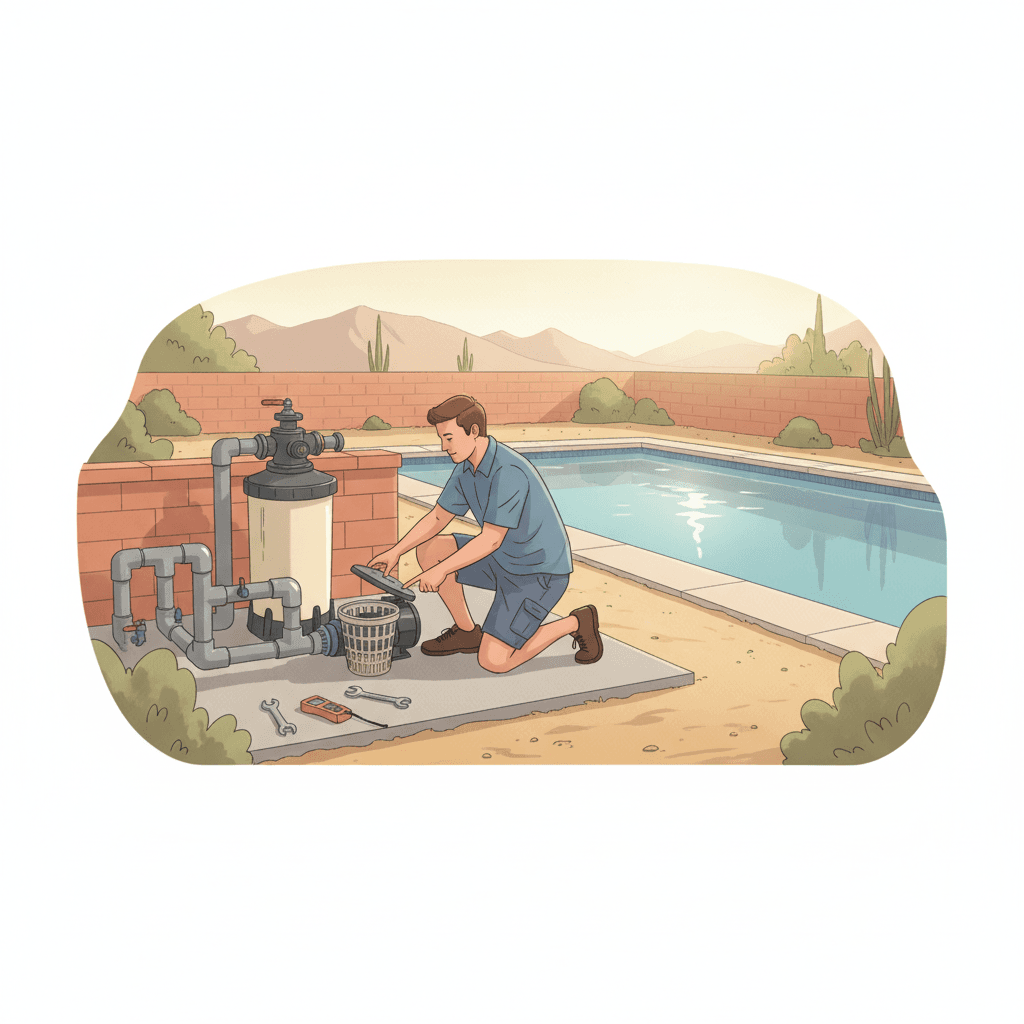
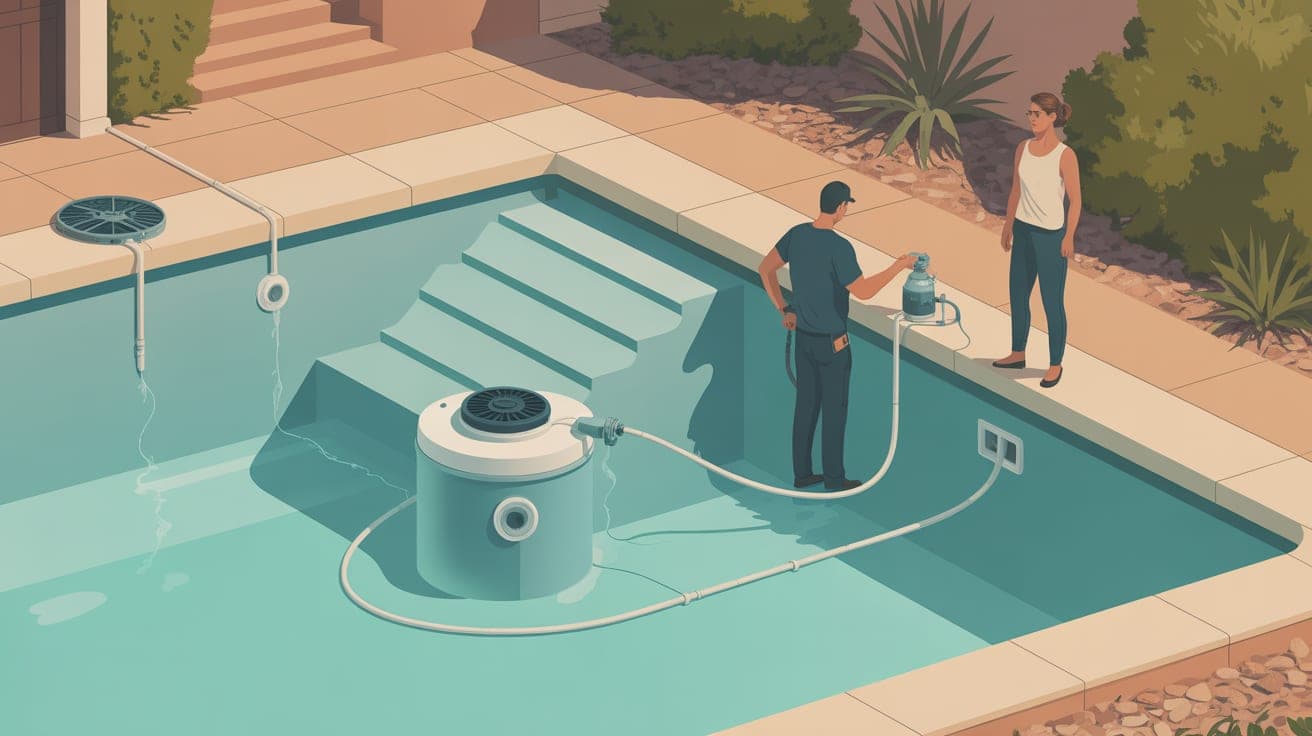
A careful inspection generally follows the water path. The technician checks water level and skimmer flow, examines the pump basket and lid seal, observes whether the pump maintains prime, reads filter pressure, verifies valve positions, and checks return flow. If the pool has a variable-speed pump, the programmed speed and run schedule matter. A pump may be mechanically sound but set too low to operate a cleaner, heater, or elevated water feature.
Filter pressure is a useful diagnostic clue, not a verdict by itself. Higher-than-normal pressure often points to restriction after the pump, such as a dirty filter or closed valve. Low pressure can indicate a suction restriction, air entering the suction side, a clogged pump basket, a worn impeller, or a leak. The normal baseline differs from pool to pool, which is why regular service records help identify meaningful changes.
Water chemistry also affects repair decisions. Low pH can be corrosive to metal components. Scale-forming water can restrict heater passages, salt cells, and fittings. Poor sanitation allows algae to consume chlorine and turn water cloudy or green even when the pump is running. If water has already deteriorated, repair and cleanup may need to happen together. Our guide to why Arizona pools turn green explains why circulation and chemistry must work together.
How do you compare which local companies offer pool repair in Tempe, AZ?
Compare Tempe pool repair companies by the quality of their diagnosis, the clarity of their scope, their residential-pool experience, and the long-term value of the proposed work. The lowest initial quote is not automatically the lower-cost choice if it replaces a part that did not cause the failure.
Use this comparison framework before authorizing non-routine work:
| What to compare | Strong repair approach | Warning sign | Why it matters to you |
|---|---|---|---|
| Diagnosis | Technician explains the observed symptom, tests performed, and likely failure point | Recommendation is based only on equipment age or a brief visual look | You can distinguish a verified repair from a guess |
| Scope of work | Written description identifies the part, labor, related seals/fittings, and what will be tested afterward | “Repair pump” or “fix leak” with no detail | A clear scope reduces surprises and makes quotes comparable |
| Repair versus replacement | Provider explains whether the existing equipment can be repaired safely and reliably | Replacement is presented as the only option without a reason | You can weigh immediate cost against efficiency, warranty, and expected service life |
| Pricing transparency | Estimate separates diagnostic work, repair work, and optional upgrades where practical | A single unexplained total or pressure to approve immediately | You know what you are paying for and can make an informed decision |
| Qualifications and safety | Company works within its scope and confirms required licensing or trade coordination for specialized work | Electrical or gas-related work is minimized or vaguely described | Proper handling protects your home, equipment, and family |
| Follow-through | Provider verifies circulation, leaks, and operation after the repair | Work ends once a part is installed | Installation alone does not prove that the system is operating correctly |
Ask each company the same questions: What did you find? What evidence supports that finding? Can the component be repaired? What additional parts or conditions could affect the final result? What should I monitor after the repair? A reliable company welcomes those questions and can explain its answers in plain language.
Service area matters too. A provider that routinely serves the East Valley can be more practical for follow-up care and recurring maintenance. If you own homes or have family pools nearby, see our pool repair service in Chandler and Mesa pool repair options.
Why does diagnosis before replacement matter for pool equipment?
Diagnosis before replacement matters because pool symptoms often have multiple causes, and replacing the most visible component can waste money without restoring proper operation. The right repair starts with the failure mechanism, not just the part that first draws attention.
Consider a pump that trips a breaker. The motor could have an internal electrical fault, but the cause could also involve the circuit, moisture at a connection, a seized motor bearing, or another condition outside the pump. The safe next step is not to install a new pump blindly. It is to identify where the fault occurs and determine what work belongs to a pool technician versus a qualified electrical professional.
A leaking pump provides another example. Water beneath the pump may come from a shaft seal, a loose union, a cracked fitting, a filter air-relief issue, or water running down from another component. A shaft seal protects the motor by keeping water out of the motor area where the rotating shaft passes through the pump housing. If that seal fails, prompt service can prevent water damage to the motor. If the leak is actually at a union, a new motor will not solve it.
Replacement does make sense in some situations. A motor with extensive damage, a cracked equipment housing, obsolete controls, or repeated failures may justify a new component. Newer equipment may also offer operational benefits, such as programmable variable-speed circulation. The trade-off is upfront cost, compatibility with existing plumbing and controls, and whether the rest of the system can support the upgrade. Review pool equipment installation options if replacement is the sounder choice.
The best recommendation is specific: repair the seal because the housing and motor test well; replace the pump because the motor and housing have separate failures; address the plumbing connection first because it is creating the air leak. Specific reasoning builds trust and gives you a clear basis for authorizing work.
How can regular maintenance reduce repair costs and downtime?
Regular maintenance reduces avoidable repairs by keeping water balanced, maintaining circulation, and finding wear before it becomes equipment damage. Maintenance does not eliminate every failure, but it gives you early warning and more time to address a developing issue.
Weekly cleaning removes debris before it blocks baskets or restricts water flow. Brushing and vacuuming reduce the organic load that consumes sanitizer. Filter care maintains flow and keeps the pump from working against unnecessary resistance. Chemical balancing protects surfaces and equipment from corrosive or scale-forming water.
Pay attention to changes between visits. A new humming sound, air bubbles at the returns, a wet spot under the equipment pad, falling water level, weak cleaner movement, or a sudden change in filter pressure deserves a call. Waiting until the pool turns green or the pump stops completely usually increases the scope of recovery.
Kenney’s Pools Service and Repair provides residential service with a practical focus: explain the problem, recommend the work that fits the condition of your pool, and keep the system operating reliably. Contact Kenney’s Pools Service and Repair — Kenneyspoolsserviceandrepair LLC — 616 S 97th Pl, Mesa, AZ 85208 — (480) 360-7149 to schedule a Tempe pool repair assessment or discuss ongoing residential pool care.
Frequently asked questions
What is the average cost of pool service in Arizona?
Pool service costs in Arizona vary with pool size, visit frequency, water condition, included chemicals, equipment needs, and whether repairs are separate from weekly maintenance. Request a written description of what each visit includes so you can compare service plans on scope, not price alone.
What are the three C’s of pool maintenance?
The three C’s of pool maintenance are circulation, cleaning, and chemistry. Circulation moves water through the filter and sanitizer system, cleaning removes debris and algae-supporting material, and chemistry keeps sanitizer, pH, and mineral balance within a range that protects swimmers and equipment.
What are some reputable pool repair companies in Phoenix, Arizona?
A reputable Phoenix-area pool repair company provides a clear diagnosis, detailed repair scope, transparent communication, and qualified handling of specialized electrical or gas work. For East Valley homeowners, Kinney Pools Inc focuses on residential pool service, maintenance, and equipment repairs.
How much should I budget for pool maintenance?
Budget for recurring cleaning and chemical care, plus a separate reserve for normal wear items and unexpected equipment repairs. Your actual maintenance budget depends on pool size, debris exposure, water features, equipment age, visit frequency, and whether repair labor and parts are included in your service plan.
Should I repair or replace my pool pump?
Repair a pool pump when testing identifies a serviceable issue such as a seal, lid O-ring, union, capacitor, or other replaceable component and the remaining equipment is in sound condition. Replace the pump when major components have failed, the housing is damaged, repairs are recurring, or a compatible upgrade offers better long-term value.
How do I know whether my pool has a suction-side air leak?
A suction-side air leak often causes air bubbles from return fittings, a pump that loses prime, a low water level in the pump basket, or inconsistent circulation. Because suction plumbing operates under vacuum while the pump runs, the leak may draw air in without visibly leaking water out.
Can a dirty filter damage pool equipment?
A severely restricted filter can reduce flow and make circulation equipment work under unfavorable conditions, which can affect cleaning, heating, and sanitizer performance. Cleaning or servicing the filter at the correct interval helps preserve flow, but the correct method depends on whether the pool uses a cartridge, sand, or diatomaceous earth filter.
- tempe pool repair
- pool equipment diagnosis
- residential pool service
- pool maintenance
- east valley pools

Kenneyspoolsserviceandrepair
Licensed Pool Service Professionals · Mesa, AZ
Kenney's Pools Service and Repair has spent over a decade keeping residential pools across Mesa and the East Valley clean, balanced and running right. Locally owned, licensed, and focused exclusively on homeowners.