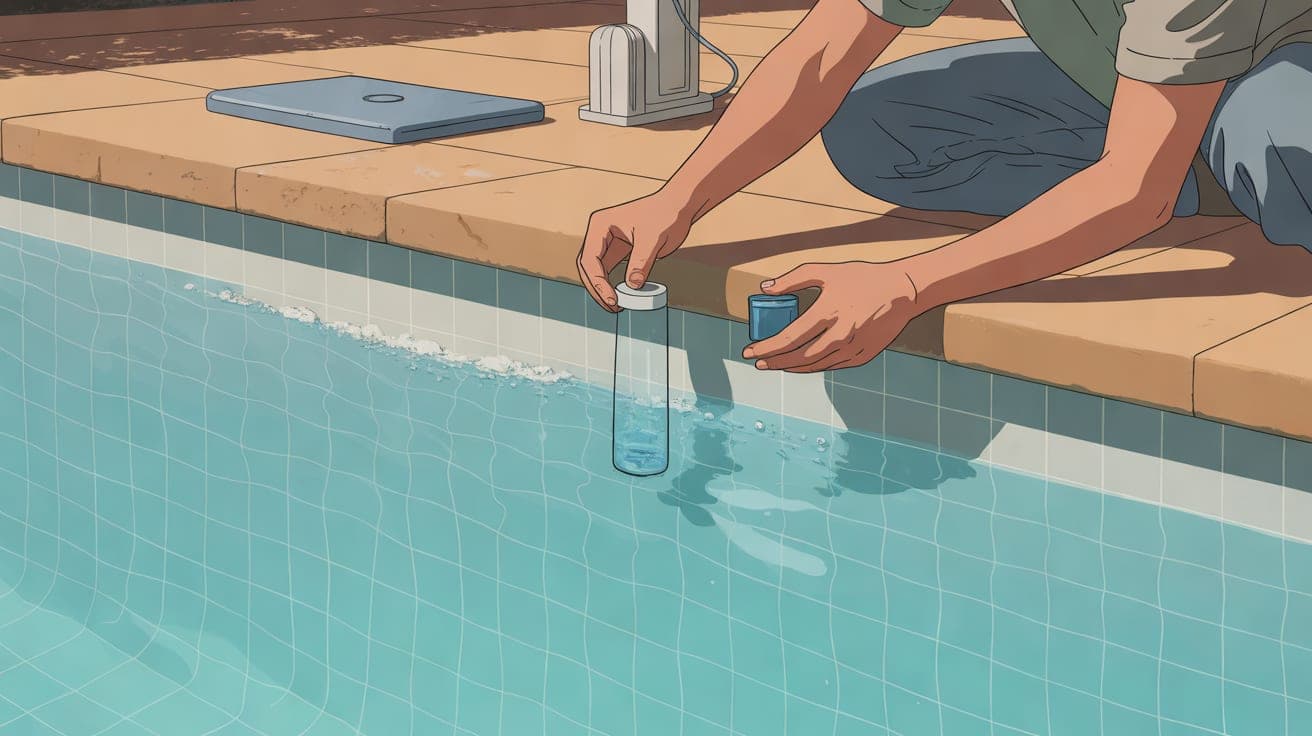

Kenney’s Pools explains cyanuric acid pool chemistry as the balance between protecting chlorine from East Valley sunlight and keeping enough active sanitizer available to control algae and contaminants. Too little CYA lets chlorine burn off quickly; too much CYA weakens chlorine’s immediate sanitizing action and can create recurring water problems.
Table of contents
- How does cyanuric acid pool chemistry affect chlorine performance?
- What is a chlorine stabilizer, and why does an Arizona pool need one?
- What cyanuric acid level supports healthy pool chemistry?
- Which chlorine products should you choose for your pool?
- Why can high CYA cause recurring algae and sanitation problems?
- Can high cyanuric acid be lowered without draining the pool?
- How can you prevent CYA from becoming a repeat problem?
- Frequently asked questions
How does cyanuric acid pool chemistry affect chlorine performance?
Cyanuric acid pool chemistry affects chlorine performance by temporarily binding much of the chlorine in the water, protecting it from UV loss while reducing the amount available to sanitize immediately.
Cyanuric acid (CYA) is a chlorine stabilizer, also called conditioner, that forms a reversible chemical relationship with free chlorine. The protected chlorine is not gone. It remains in reserve and releases as active chlorine is consumed. In an uncovered Mesa-area pool, that protection matters because intense sunlight can deplete unstabilized chlorine rapidly.
The trade-off is direct: higher CYA preserves chlorine longer, but it also lowers the concentration of hypochlorous acid, the most active sanitizing form of chlorine. A pool with excessive CYA can show an acceptable free-chlorine test result while still responding too slowly to bather waste, algae spores, and early contamination.
This is why a single chlorine number never tells the whole story. Reliable service considers CYA, free chlorine, pH, water temperature, circulation, visible water condition, and the products being added every week. CYA does not sanitize water on its own. It changes how your chlorine behaves.
What is a chlorine stabilizer, and why does an Arizona pool need one?
A chlorine stabilizer is cyanuric acid added to outdoor pool water to shield chlorine from the sun’s ultraviolet rays and extend its useful life.
Without stabilizer, an outdoor pool can lose chlorine faster than normal daily dosing can economically replace it. With the right amount of stabilizer, chlorine lasts longer between service visits and is less vulnerable to bright desert sun. That can make sanitation more dependable.
CYA becomes a problem only when it is treated as a set-it-and-forget-it chemical. It accumulates. Evaporation does not remove it because water leaves as vapor while dissolved CYA remains behind. Repeated use of stabilized chlorine can raise CYA month after month, especially in pools with little backwashing, splash-out, overflow, or planned water replacement.
A dependable maintenance plan tests stabilizer instead of assuming it is correct. If your pool repeatedly turns dull or green despite regular chlorine additions, high CYA belongs on the diagnostic checklist alongside circulation, filtration, phosphates, pH, and hidden equipment problems. Our team can perform professional pool chemical balancing that identifies the cause instead of repeatedly adding chemicals that do not solve it.
What cyanuric acid level supports healthy pool chemistry?
The right cyanuric acid level is the level that provides sunlight protection without forcing your pool to operate at an impractically high chlorine level.
There is no single CYA target that fits every residential pool. Your ideal target depends on the sanitizer system, whether the pool is covered, local operating requirements, and how the pool is used. Traditional chlorine pools commonly operate with moderate CYA, while salt-chlorine pools may be managed with a different CYA target because their chlorine is generated continuously. The correct free-chlorine target must always be matched to the actual CYA reading.
Here is what the two extremes look like in real residential pools:
- CYA too low: Chlorine is consumed rapidly in sunlight. You may add chlorine often, see unstable readings, and struggle to hold a sanitation residual through a hot afternoon.
- CYA in the working range: Chlorine receives UV protection while remaining responsive enough for routine sanitation and algae prevention.
- CYA too high: Chlorine remains heavily buffered. The pool may need a higher sustained free-chlorine level to provide the same sanitation strength, and a normal-looking chlorine reading may no longer be sufficient for the CYA present.
Do not try to solve low CYA by continuously using stabilized tablets without testing. Do not try to solve high CYA by simply adding more chlorine indefinitely. Both approaches can create a cycle of unnecessary chemical use and unreliable water quality.
Which chlorine products should you choose for your pool?
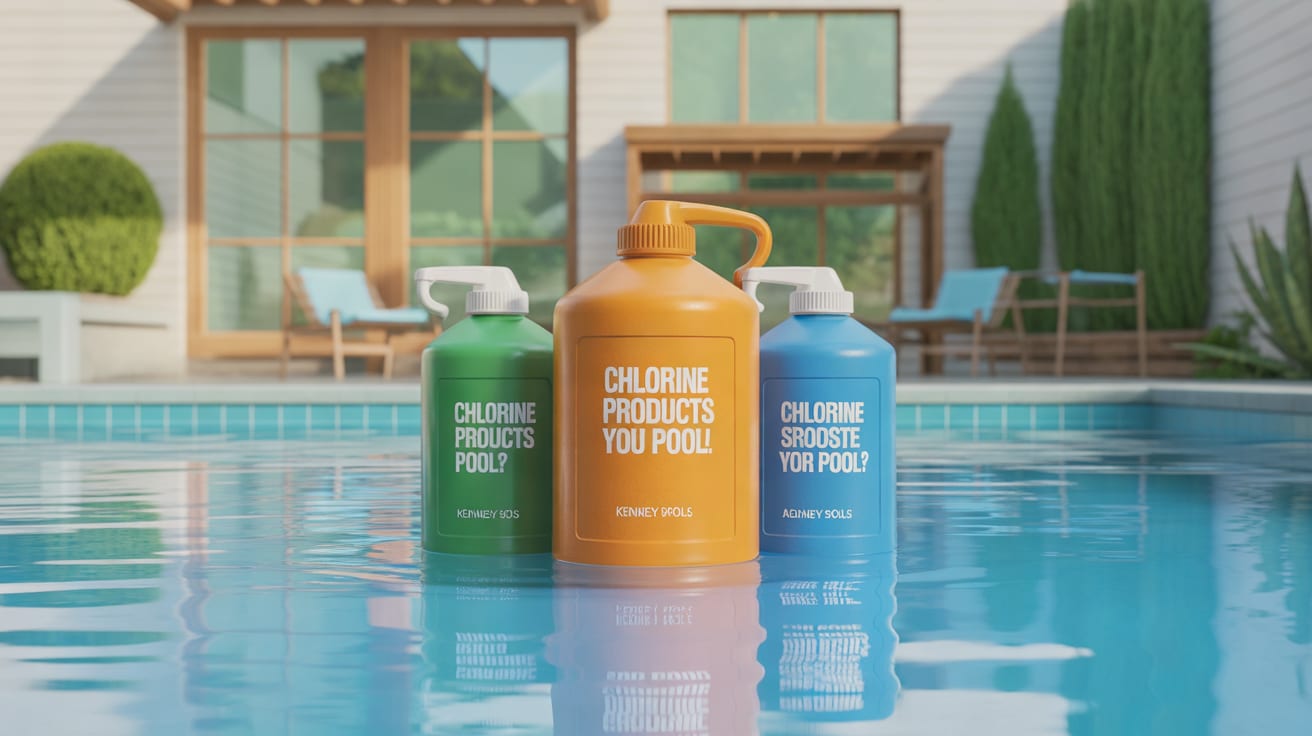
Choose chlorine products based on what they add besides chlorine, because stabilized products add CYA over time while unstabilized products do not.
| Sanitizing approach | Adds cyanuric acid? | Best decision criteria | Main watch-out |
|---|---|---|---|
| Stabilized chlorine tablets or granular stabilized chlorine | Yes | Useful when CYA is low and sunlight protection is needed | Regular use can steadily raise CYA beyond a manageable level |
| Liquid chlorine | No | Useful when CYA is already adequate or high and you need chlorine without more stabilizer | Requires consistent dosing and proper storage; it does not provide UV protection by itself |
| Unstabilized granular chlorine | No | Useful for targeted chlorination where CYA should not increase | Some formulations can affect calcium hardness or pH, so the full water balance matters |
| Granular or liquid CYA conditioner | Adds CYA directly | Best when testing confirms low stabilizer and you need a measured correction | Adding too much is difficult to reverse without removing water |
Granular CYA is typically dissolved slowly and should be introduced exactly as directed for the product and circulation system. Liquid CYA is often a suspended conditioner that can be easier to measure and apply, but it still raises the same CYA level and should never be poured in casually. The choice between liquid and granular conditioner is mostly about handling, speed, and accurate dosing—not a different long-term chemical result.
Never mix pool chemicals together in a container. Add each product separately, with circulation running, and give the water time to distribute one addition before making another. Chemical compatibility and application directions matter as much as the dose.
Why can high CYA cause recurring algae and sanitation problems?
High CYA can contribute to recurring algae problems because it reduces chlorine’s active sanitizing strength, allowing contamination to gain ground even when a basic chlorine test appears acceptable.
Algae control depends on maintaining enough active chlorine for your CYA level, not merely seeing any chlorine on a test strip or test kit. If CYA has climbed, the same free-chlorine reading that worked last season may no longer provide the same result. Hot water, heavy use, wind-blown debris, and long pump downtime make the issue more visible.
High CYA also makes recovery harder after algae begins. Large chlorine additions can temporarily improve the appearance of water, but the pool may turn cloudy or green again if the stabilizer-to-chlorine relationship remains out of balance. Brushing, filtration, circulation, and cleaning are part of the correction because algae and debris consume chlorine continuously.
If you are seeing repeat green-water episodes, review our guidance on why Arizona pools turn green and have the full chemistry checked. A green pool is not always a “need more shock” problem.
Can high cyanuric acid be lowered without draining the pool?
High cyanuric acid is reliably lowered by removing and replacing a calculated portion of pool water, because CYA is dissolved in the water and does not evaporate or filter out.
Some products are marketed as CYA reducers, but they are not a substitute for verifying results with accurate testing and planning the water exchange. If the CYA level is significantly above the operating target, partial drain-and-refill work is the dependable correction. The amount of water replaced should be calculated from the current reading, the desired reading, pool volume, water restrictions, and the condition of the pool surface and equipment.
Draining a pool in the East Valley requires care. Groundwater conditions, structural considerations, heat, hydrostatic pressure, and the type of finish all matter. Kenney’s Pools can assess whether professional pool draining in Mesa is appropriate and coordinate the chemistry correction safely.
An acid wash does not lower cyanuric acid. Acid washing addresses certain surface staining or mineral buildup; it is not a water-chemistry treatment. If high-CYA water replacement reveals surface issues that need separate attention, our Mesa acid wash service can be evaluated on its own merits.
How can you prevent CYA from becoming a repeat problem?
You prevent recurring CYA problems by testing stabilizer routinely, tracking every stabilized product added, and selecting chlorine based on the pool’s current CYA reading.
Keep a simple record of CYA, free chlorine, pH, calcium hardness, alkalinity, and products used. This makes an unexplained chemistry shift easier to diagnose. Test CYA after substantial water replacement and before changing your routine sanitizer. Avoid adding conditioner “just in case”; a measured addition is safer than a guess.
Your service plan should also account for the pool’s actual conditions. A shaded pool, a solar-heated pool, a heavily used pool, and a salt pool do not all need the same sanitizer strategy. Dependable pool care means adjusting to your water, not following a one-size-fits-all chemical schedule.
For accurate CYA testing, a practical correction plan, and residential pool service built around clear answers, contact Kenney’s Pools Service and Repair. We serve Mesa and surrounding East Valley homeowners with transparent maintenance and repair guidance. Kenney's Pools Service and Repair LLC — 616 S 97th Pl, Mesa, AZ 85208 — (480) 360-7149.
Frequently asked questions
What is a chlorine stabilizer?
A chlorine stabilizer is cyanuric acid, a pool chemical that protects free chlorine from ultraviolet sunlight. It helps outdoor pools retain chlorine longer, but excessive stabilizer reduces chlorine’s immediate sanitizing strength and requires a higher matching free-chlorine level.
Can I add CYA and chlorine at the same time?
You can add cyanuric acid and chlorine to the pool during the same service period, but never mix them together or add them simultaneously in the same spot. Add each chemical separately according to its directions, keep the pump running, and allow circulation between additions.
What happens if your CYA is too low?
If CYA is too low, sunlight destroys free chlorine quickly, especially in an uncovered Arizona pool. Chlorine readings can fall rapidly, daily chemical demand increases, and the pool may lose its dependable sanitation residual before the next service visit.
Does sunlight reduce cyanuric acid?
Sunlight does not meaningfully reduce cyanuric acid under normal pool conditions. CYA is usually lowered through splash-out, backwashing, leaks, overflow, draining, or dilution from added water, not through UV exposure.
Is cyanuric acid the same as chlorine?
Cyanuric acid is not chlorine and does not sanitize pool water. Cyanuric acid is a stabilizer that protects chlorine from sunlight, while free chlorine is the sanitizer that controls algae, bacteria, and bather waste.
How do I know if my CYA is too high?
High CYA is confirmed by a proper stabilizer test, not by appearance alone. Common warning signs include repeated algae, chlorine that seems ineffective, unusually high chlorine demand during cleanup, and continued water problems despite regular use of stabilized tablets or granular chlorine.
Do I need to drain my pool to lower cyanuric acid?
A partial drain-and-refill is the most reliable way to lower excessive cyanuric acid because CYA remains dissolved in the water. The correct replacement amount depends on pool volume, current CYA, target CYA, and safe draining conditions for the property.
- cyanuric acid
- pool chemistry
- chlorine stabilizer
- pool maintenance
- mesa pools

Kenney's Pools
Licensed Pool Service Professionals · Mesa, AZ
Kenney's Pools Service and Repair has spent over a decade keeping residential pools across Mesa and the East Valley clean, balanced and running right. Locally owned, licensed, and focused exclusively on homeowners.