
Pool Draining & Refill · Mesa & the East Valley
Sometimes The Water
Needs A Reset.
Draining is not the service. Working out whether your water actually needs replacing — and then how much — is the service. Most pools that get drained needed a quarter of it.
- Test before draining
- Partial where partial works
- Refilled and rebalanced
Pool draining is replacing some or all of your water when what is dissolved in it — stabiliser, calcium, total dissolved solids — has climbed past the point chemistry can manage. There is no chemical that removes those things, so dilution is the only remaining lever. A test decides whether it is needed and how much; the refill and rebalance are half the job.
Why Arizona Water Ages
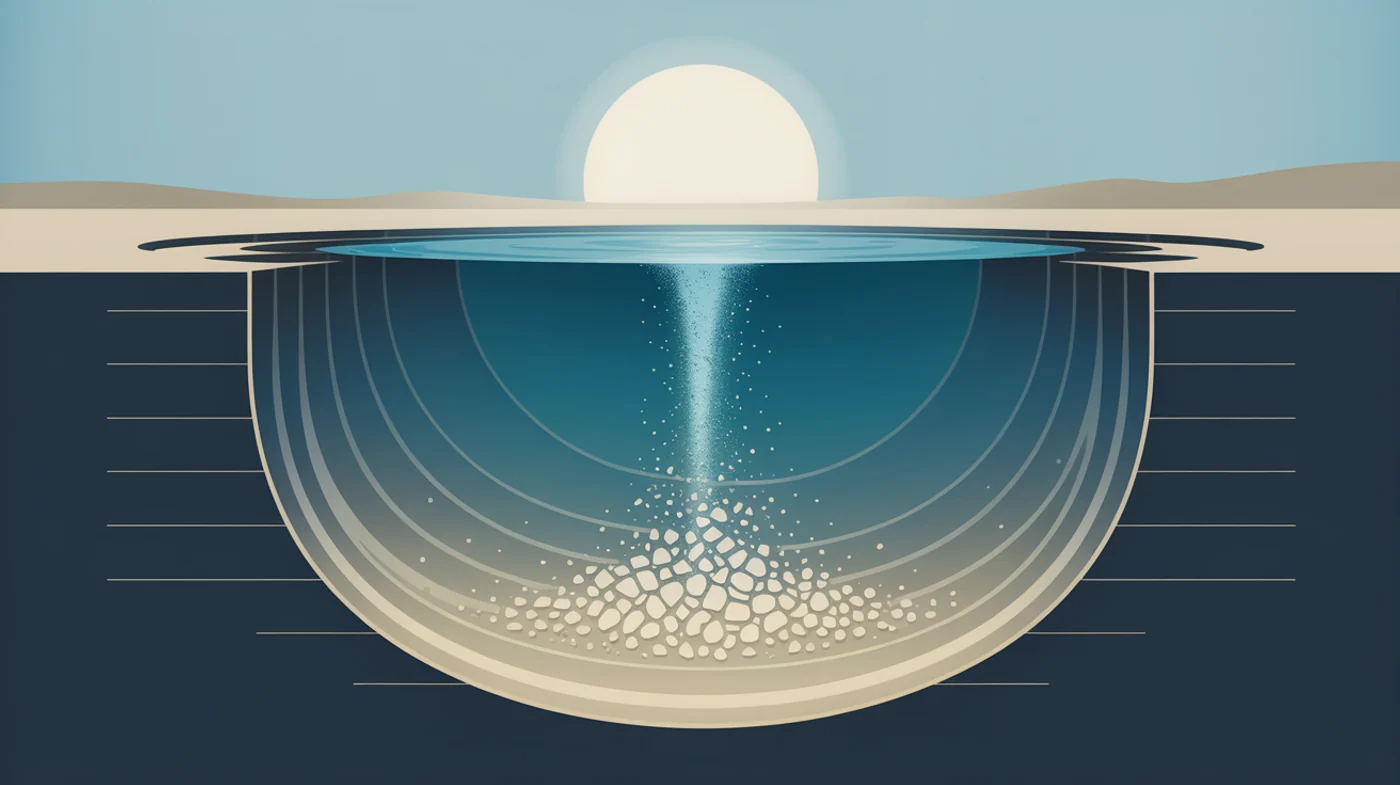
The water evaporates. The minerals don't.
This is the whole story of pool water in the desert, and it runs in a loop that adds rather than resets.
Fill
Mesa water arrives already hard — roughly 12 to 13 grains per gallon, about 205 to 220 ppm of calcium. The pool starts near the bottom of the recommended band before anything happens to it.
Heat
A long season of 100°F-plus air and 95°F-plus water. Evaporation runs all year here, not just in July.
Evaporation
Water leaves as vapour. Everything dissolved in it — calcium, salts, dissolved solids — stays behind in what remains.
Top up
You replace the missing water with more hard water, which brings its own minerals with it. The cycle adds rather than resets.
Concentration
Calcium and total dissolved solids climb. Separately, cyanuric acid climbs for a different reason: every stabilised chlorine tablet adds more, and nothing removes it.
Manage — then replace
Chemistry controls the scaling tendency for a long time. Eventually the water carries more than chemistry can manage, and the only remaining lever is replacing some of it.
One correction worth making: calcium and dissolved solids concentrate because evaporation removes water and leaves them behind. Cyanuric acid climbs for a different reason — it is added with every stabilised chlorine tablet and is neither consumed nor evaporated. Same outcome, different mechanism, and it changes what dilution does to each of them.
The Maths Nobody Shows You
What replacing part of the water actually does
Replace half the water and you halve the stabiliser. Do the same for calcium and you do not halve it — you move it halfway toward whatever your fill water is carrying. Same maths, opposite intuition.
Cyanuric acid after replacement
Test First, Drain Second
Does your pool actually need draining?
Eight reasons people arrive at this page. Only some of them genuinely need water replaced, and several have a cheaper answer.
My stabiliser (CYA) is very high
This is the clearest genuine case for replacing water. Cyanuric acid is neither consumed nor evaporated and there is no practical chemical that removes it, so dilution is the only route down.
What to test
- Cyanuric acid, to know how far above the ceiling you actually are
- Free chlorine, to see how much performance you are losing
- Total dissolved solids
Could a partial drain do it?
Usually yes. Because fill water contains no cyanuric acid, a partial replacement lowers it proportionally — replacing half the water roughly halves it.
Confirm with a test before draining anything — Chemical balancing
My calcium hardness is very high
Also a real case, with one important caveat: you cannot dilute calcium below what your fill water already contains. In Mesa that floor is around 205 to 220 ppm.
What to test
- Calcium hardness in the pool
- Calcium hardness of your fill water, tested separately
- pH and total alkalinity
Could a partial drain do it?
Often, but the maths is different. Each replacement moves the pool toward the fill-water level rather than toward zero, so very high calcium can need more replacement than people expect.
Scale already on surfaces is separate work — Acid wash
My TDS reading is high
One number rarely tells the whole story. Total dissolved solids is a sum of everything dissolved, so a high reading is a prompt to find out WHAT is high rather than a verdict on its own.
What to test
- The individual constituents — calcium, cyanuric acid, salt
- Whether the pool is a salt pool, which raises TDS by design
- How the water is actually behaving
Could a partial drain do it?
Depends entirely on what is driving it. A salt pool reads high TDS normally and that alone is not a reason to drain.
The chemistry will not stay balanced
Sometimes saturated water, and often something much cheaper to fix. It is worth ruling out the ordinary causes before replacing 15,000 gallons.
What to test
- Total alkalinity — a low buffer is the usual reason pH will not hold
- Cyanuric acid
- Calcium hardness and TDS
- Filter pressure against its clean baseline
Could a partial drain do it?
Only once testing shows the water itself is the limitation rather than the dosing order.
Most of these are a chemistry problem, not a water problem — Chemical balancing
I have heavy scale on the tile
Draining does not remove scale. Replacing water lowers the calcium in the water so new deposit stops forming — the deposit already bonded to tile and plaster is mechanical work.
What to test
- Calcium hardness
- pH and alkalinity
- A look at the surface itself
Could a partial drain do it?
Often paired: dilute the water so it stops getting worse, then deal with the existing deposit separately.
Removing what is already there — Acid wash
I'm preparing for an acid wash
An acid wash requires an empty pool, so the drain is part of that job rather than a separate decision. The wastewater rules are different too — see the disposal section below.
What to test
- Whether the surface genuinely needs an acid wash at all
- Plaster condition
- Water chemistry before the drain
Could a partial drain do it?
No — surface work needs the pool empty.
What an acid wash involves — Acid wash
The water is years old
Age alone decides nothing. Some pools go a long time on well-managed water; others need replacing sooner because of how they are run and topped up. The test result matters, the calendar does not.
What to test
- Cyanuric acid
- Calcium hardness
- Total dissolved solids
- How the water is behaving day to day
Could a partial drain do it?
Frequently the right answer — a partial replacement resets the trend without emptying the pool.
A pool store told me to drain it
Worth a second opinion, and worth seeing the actual numbers. Sometimes it is exactly right. Sometimes the same result comes from correcting the dosing order, or from replacing a quarter of the water rather than all of it.
What to test
- The full set of readings, in writing
- Your fill water, tested separately
- Filter and circulation condition
Could a partial drain do it?
Very often. Full drains get recommended where partial ones would do.
How Much
You probably don't need to empty the whole pool
Full drains get recommended where partial ones would do. The difference is not just cost — it is risk.
| Partial replacement | Full drain and refill | |
|---|---|---|
| What it is for | Bringing a dissolved constituent back into range — stabiliser, calcium, dissolved solids. | Surface work that needs an empty pool, or water so far gone that partial replacement will not reach the target. |
| How much water | A calculated share, based on the test result and what the fill water contains. | All of it. |
| Surface exposure | The finish stays wet. This is the single biggest safety advantage. | Plaster is exposed to sun and heat until the pool is refilled. |
| Structural risk | Minimal — the pool keeps most of its water weight. | Needs care. An empty shell and groundwater are a genuine engineering consideration, not a formality. |
| Time empty | None. | As short as possible. Refilling promptly is part of the job, not an afterthought. |
| Water used | Less — often much less. | A full pool volume. |
| Afterwards | Retest and rebalance the blended water. | Full startup chemistry on entirely new water. |
While It Is Empty
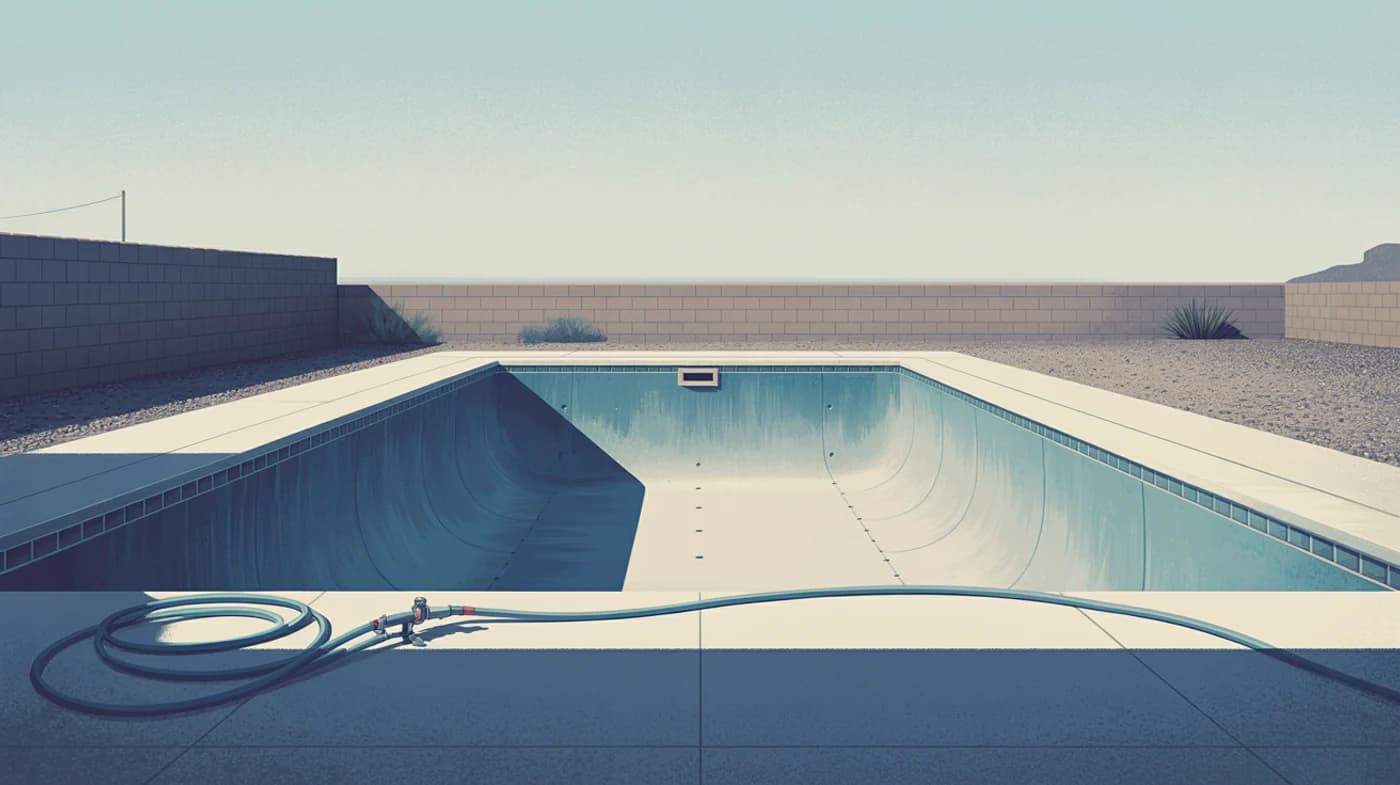
An empty pool is on a clock
The goal is not to drain it. The goal is to get water back in it. Everything about how a full drain is planned follows from that.
Surface exposure
Plaster is designed to live underwater. Left dry in direct Arizona sun it can dry unevenly and craze, and the damage is permanent. This is why the goal is not just to drain it — it is to get water back in it.
Groundwater pressure
An empty shell has lost the weight that was holding it down. Where groundwater is high, that is the condition people mean when they talk about a pool "popping". It is uncommon, it is site-specific, and it is a reason to have someone assess the site rather than guess.
Heat
Surface temperatures on exposed plaster in an Arizona summer are far above air temperature. Timing matters, and so does having the refill lined up before the drain starts.
Delayed refill
Every additional hour empty is additional exposure. A drain that stalls because nobody planned the refill is the version of this job that causes damage.
You will read "never drain a pool in summer" a lot. It is not that simple — what matters is the site, the surface, the conditions and how fast the refill happens. It is true that autumn is the comfortable window for a planned correction, and that July is the least forgiving month to improvise one.
Responsible Disposal
Fifteen thousand gallons has to go somewhere
And where it can go depends on which city you are in — genuinely, not as a disclaimer. Gilbert and Queen Creek permit a conditional curb route that Mesa directs you away from. Every rule below was read off the city's own guidance and checked twice.
Mesa
Mesa publishes two endorsed routes, and neither needs a permit or notification.
- 1
Onto your own landscape
AllowedMesa says to drain to "your desert landscape, lawn or rocky areas on your property and allow the water to percolate into the ground." Move the hose regularly so you do not create standing water that breeds mosquitoes, and keep it off your neighbour's property.
- 2
Your home's sanitary sewer cleanout
AllowedExplicitly endorsed: "You can also drain or backwash your pool into your home's sanitary sewer cleanout." Mesa asks that the water be near neutral (pH 6–8) and that you shut off power to the filtration system and the auto-fill before you start.
- —
Street, gutter or storm drain
Do notMesa discourages this and its own brochure calls it prohibited, citing city code. Mesa defines its storm sewer system to include curbs and gutters, so "just to the curb" is not a way around it.
Worth knowing
- Mesa recommends a discharge rate of about 12 gallons per minute to the sewer cleanout. That is published guidance, not an ordinance limit, and Mesa notes it depends on your drain line.
- For the landscape route Mesa suggests waiting 3–7 days after treatments so chlorine dissipates, with pH in the 7–8 range, and draining slowly to avoid runoff.
- Do not let soil, sediment, rock or debris pass into the sewer cleanout when backwashing — it can cause a sewer overflow.
- Mesa publishes a salt-tolerance plant table. It lists fruit trees, roses, star jasmine, hibiscus, vegetables and annual flowers among plants NOT to water with pool water.
Gilbert
Gilbert publishes three ranked options and names its preferred one.
- 1
Your yard or property — the Town's stated preference
AllowedAllowed "if and only if" the area can absorb the water without running off into a ditch, street or other conveyance. Gilbert marks this option "Preferred".
- 2
The sanitary sewer cleanout
AllowedFor use when you do not have the space on your property. Gilbert specifically names this as the route for "water with a high chemical level or saltwater pools."
- 3
Curb and gutter
With conditionsPermitted for "CLEAN de-chlorinated water only". Gilbert adds: not in lake communities, not if your street has flooding issues, and do not drain a saltwater pool in the street.
Worth knowing
- Backwash is barred from the street outright: water carrying sediment must go onto your yard or into the sewer cleanout.
- Never plumb a permanent connection from the pool pump to the sewer cleanout or the curb — Gilbert says that is a Town Code violation.
- Filter rinse water must not reach the gutter or roadway. Rinse onto a permeable surface, or collect it and dispose of it into the sanitary sewer.
- If your community has an HOA, Gilbert asks you to check its policy as well as the Town's.
- Gilbert does not offer a utility bill credit for refilling a pool.
Queen Creek
Queen Creek publishes a formal Pool Draining Policy with three numbered options.
- 1
Your own personal property, first
AllowedThe Town asks you to drain all or part of the water — including backwash — onto your own property first, without letting it run off your property.
- 2
The sewer clean-out in front of your home
AllowedFor when you cannot drain it all onto your property, when you have a saltwater pool, or when you are only backwashing. The Town warns this is only for homes on the public sewer — septic systems are not designed for this volume.
- 3
Curb or gutter, to the retention basin
With conditionsAllowed with conditions: the water must be dechlorinated first, your street must not generally have flooding problems, your hose must reach the curb to prevent soil erosion, and you must not flood a neighbour.
Worth knowing
- The Town publishes no chlorine ppm target, no holding time and no test method for its dechlorination condition — only the requirement itself.
- Queen Creek cautions that pool water carries more salt and chlorine than tap water, so check it is safe for the plants and grass you intend to irrigate.
- The Town encourages using drain and backwash water to irrigate your own landscape where you can.
Chandler
Chandler is the only city here that gates the street behind a written exception you have to apply for and then post on site.
- 1
Onto your own landscape
AllowedChandler names this outright: "The best place to drain water is on your landscape." Drain slowly so the water soaks in rather than running off, and move the discharge hose to a different area of the yard each time so salt does not build up in one spot. The city's reasoning is sunlight rather than a chemical test — "any chlorine in the water is rapidly inactivated by sunlight".
- 2
Your home's sanitary sewer cleanout
AllowedThe other endorsed route, and no permit is needed for it: "No permit is needed to drain your pool if it is drained into the sanitary sewer cleanout or maintained on your property." The recommended flow rate is "no greater than 12 gallons per minute", and Chandler is explicit that the safe rate depends on the size of your drain line, the distance to the sewer main and the condition of the pipes.
- 3
The street — only via an approved exception request
With conditionsNot a self-serve route. "If you are unable to locate the sanitary sewer cleanout, an exception to drain into the street can be requested." You apply on the city's form, which asks the date, who will be doing the draining, your reason the cleanout cannot be used, and asks you to certify the water is clear, free of chemicals and neutral pH. Chandler tells you to "post this form as your authorization to drain into the City Street". No sediment or pollutants — algae, salt, diatomaceous earth, sludge and acid are all named — no blocking the right-of-way, no erosion, and you clear up anything left in the street.
- —
Alleyways
Do notRuled out flatly — "No discharges are allowed in alleyways." That sits in the stipulations of the street exception itself, so even a homeowner who has been granted the street route still cannot use an alley.
- —
A permanent pipe plumbed off your property
Do notProhibited. Pipes "hard plumbed" to discharge off property "are considered a direct connection to the storm drain". Chandler adds that a permanent drain line may also violate the City plumbing code or County health regulations.
Worth knowing
- Chandler publishes NO numeric dechlorination standard anywhere in its pool guidance — no chlorine ppm target, no holding time, no test method. The only test on the street exception is your own yes/no answer that the water is "clear, free of chemicals and have a neutral pH". Another city's number does not apply here.
- A safety point Chandler makes and we will repeat: "Using a cleanout in the wall is risky, and the potential for water backing up into the home is great." Check straight away that nothing is backing up into showers or tubs, and kill the pump the moment it does.
- Pool chemicals are prohibited from entering the storm drain outright. That sits underneath the street exception rather than being waived by it.
- If the water will reach an HOA retention basin, the city's exception is not enough on its own — "authorization from that entity is required and is not provided by this exception."
- The exception is enforceable: "Failure to adhere to the stipulations of this exception may result in a Notice to Correct or a request to immediately cease the discharge."
- Backwash does not automatically need the cleanout — Chandler says it "is not necessary if the discharge can be maintained on your private property".
- The city keeps no records of where cleanouts sit on private property, which matters because failing to find yours is the stated trigger for the street exception.
- Chandler publishes a three-tier salt-tolerance plant list. The "do NOT use backwash water" tier names Algerian Ivy, Chinese Hibiscus, Fraser's Photinia, Fruit Trees, Hopbush, Jojoba, Queen Palm, Roses, Star Jasmine and Willow.
- There is no billing relief for the refill: "The city does not give discounts when refilling your pool."
Tempe
Tempe is the only city here that sets a pool-size threshold — under 35,000 gallons changes what you are allowed to do with the water.
- 1
The surface of your own property
AllowedEndorsed in the same sentence as the sewer route: "You can drain or backwash your pool, spa or fountain to the surface of your own property or into your home's sanitary sewer cleanout." Send it to "desert landscape, lawn, retention basins or rocky areas on your property and allow the water to percolate into the ground", move the hose frequently so you do not create stagnant water that attracts mosquitoes, and keep the water on your own property.
- 2
Your home's sanitary sewer cleanout
AllowedThe other endorsed route. Tempe asks for a pump "with a flow rate of less than 12 gallons per minute", the hose secured inside the cleanout so it cannot dislodge, and close monitoring so water does not back up into the house or overflow the cleanout. Keep soil, sediment, rock, sand and debris out — that is what causes an overflow.
- 3
A right-of-way other than an alley — under 35,000 gallons only
With conditionsTempe: "Pool water must never be discharged to alleys. However, residential pools of less than 35,000 gallons may be drained to other rights-of-way." That permission is conditional on all of the following: the water clear, free of debris and measuring zero for chlorine or bromine; a pump of no more than 1.5 horsepower; and drainage monitored to avoid flooding, damage and traffic hazards.
- —
Backwash to a storm drain, street or alley
Do notProhibited outright, and deliberately separate from the drain route above: "Backwashing into a storm drain or onto a street, alley or other City of Tempe right-of-way is prohibited." Backwash carries sediment, so it goes onto your own property or into the cleanout. Draining pool water into a sanitary sewer manhole installed in the street is prohibited too.
Worth knowing
- Tempe sets the strictest pre-drain test of the cities here: the water must measure zero for chlorine AND bromine on a pool test kit before it goes anywhere. Bromine is named explicitly, which no other city on this page does.
- Above 35,000 gallons — or for any commercial pool — you must contact Environmental Services on 480-350-2678 for authorization BEFORE draining. It is a phone call, not a form.
- The 1.5 horsepower cap and the "clear, free of debris" test attach to the right-of-way route specifically. They are not conditions on the landscape or cleanout routes.
- Tempe writes every one of these rules for "pools, spas and fountains", so a spa or a fountain is covered by exactly the same guidance.
- The city's first published guideline is the least glamorous one: dispose of pool chemicals and their empty containers properly.
Apache Junction
Apache Junction publishes a dedicated stormwater brochure on pool discharge, and it is the only city here that gives a numeric dechlorination target. It names chlorinated pool water as the most common illicit discharge in the city.
- 1
A sanitary sewer drain from your home
AllowedThe City instructs residents to "drain clear pool water into a sanitary sewer drain from your home such as a cleanout or bathtub."
- —
Septic systems
Do notExplicitly ruled out: draining a pool into a septic system would exceed its design capacity.
- —
Anything that leaves your property
With conditionsIf discharge reaches city storm drains, culverts, basins, gutters or roadways it must be dechlorinated and be visually clear, colourless and free of suspended solids, floating material and debris. Note that city code separately prohibits discharging pool water into public streets and rights-of-way.
Worth knowing
- Green pools must be treated clear before draining.
- The City publishes a numeric dechlorination standard: free chlorine measured at "0" with a pool test kit, or total residual chlorine at or below 0.02 mg/L with a more sensitive device.
- Pools without cyanuric acid dechlorinate naturally, the City says typically within about 10 days depending on sun and temperature. Pools using cyanuric acid need a neutraliser.
- The City is direct about why: chlorine "can physically harm wildlife and natural vegetation as it breaks down."
Checked 7 August 2026
There is a state layer above your city — and right now there is a gap in it
Arizona regulates discharges that reach protected surface waters, and routing water through a storm drain does not take it out of that regulation. The mechanism has been ADEQ's AZPDES De Minimis General Permit, which covered dechlorinated freshwater pool drainage without needing an application.
That permit — AZG2021-001 — expired at midnight on 31 May 2026. ADEQ has published that the replacement, AZG2026-001, reissues on 1 September 2026, and the draft keeps pool drainage in the same automatically-authorised category.
This matters practically. Mesa's pool page still describes a conditional storm-drain route that depends on that permit being in force. The text is accurate and it is live on the city's site, but the permit behind it is currently expired. We are not going to tell you that route is available while that is true.
In practice: None of this affects the two routes almost every Mesa homeowner actually uses — your own landscape, or your sanitary sewer cleanout. Those are endorsed by the city, need no permit, and do not depend on the state permit at all.
Two Different Jobs
Draining for water quality and draining for surface work are two different jobs
If the pool is being emptied so the surface can be acid washed, the water coming off that job is not ordinary pool water. Mesa is explicit about it: because pool-repair discharges can carry solid particles and high concentrations of chemicals, wastewater from those activities is not allowed to go to the storm sewer system OR the sanitary sewer system.
That is a genuine constraint on how the job is done, and it is one of the reasons an acid wash is not a job to improvise. If we are acid washing, we plan the disposal as part of the work rather than discovering it at the end.
What an acid wash actually involvesHow The Job Runs
Twelve steps, and the first one is a test
Six of the twelve happen after the water is back in. That ratio is the point.
Test first
The whole decision rests on numbers. Stabiliser, calcium, dissolved solids — and your fill water, tested separately, because it sets the floor.
Establish why
Replacing water is the answer to a specific problem. If the readings do not support it, we will say so.
Partial or full
Calculated from the readings and what the fill water contains — not a default.
Plan the discharge
Which route this property can actually use, under the rules that apply in your city.
Check conditions
Site, season and how quickly the pool can be refilled. An empty pool is on a clock.
Controlled drain
At a rate the discharge route can take, monitored rather than left running.
Inspect while it is accessible
On a full drain, the surface is visible in a way it never is again until the next one.
Refill promptly
The goal is water back in the pool. This is planned before the drain starts.
Restart equipment
Pump primed, air purged, system brought back up and checked under real flow.
Test the new water
Fresh fill water is not balanced water. It has its own pH, alkalinity and calcium.
Rebalance
Alkalinity, then pH, then sanitiser — the same order that works on any pool.
Verify
Retest once it has circulated, so the corrections are confirmed rather than assumed.
Refill
Fresh water isn't balanced water
A brand new pool full of water is not a solved pool. It is an unbalanced pool with no sanitiser in it, sitting in the Arizona sun.
Fresh water is not balanced water
Water out of the hose has its own pH, its own alkalinity and — in Mesa — roughly 205 to 220 ppm of calcium before you have added anything. It is new, not neutral.
Calcium does not start at zero
This is the one that surprises people. A freshly filled Mesa pool already sits near the bottom of the recommended 200–400 ppm band for plaster, which is why you cannot dilute your way below the fill water.
Sanitiser has to be established
New water has no sanitiser in it at all and no stabiliser to protect what you add. In Arizona sun, that combination does not stay clean for long unattended.
A new surface is at its most vulnerable
If the pool has just been acid washed or replastered, the startup chemistry matters more than at any other point in the finish's life. Aggressive water on a fresh surface does damage immediately.
Before You Spend Anything
Not every bad test needs a drain
Five situations where replacing the water is the expensive way to avoid a cheaper job.
pH will not hold
Almost always a low alkalinity buffer, not saturated water. Correcting the buffer is a fraction of the cost.
Chemical balancingThe water is cloudy
Check filtration and circulation before replacing the water. A loaded or spent filter produces cloudiness no drain fixes.
Filter installationThe pool is green
Algae needs treatment, filtration and brushing. Draining a green pool is usually the expensive way to avoid a cheaper job.
Pool cleaningChlorine will not hold
Test stabiliser first. If it is genuinely at the ceiling, dilution is right — but if it is low, you need the opposite of a drain.
Chemical balancingFlow is weak
That is a pump, plumbing or filter question. New water will not move any better through a restricted system.
Pool repair
Answers
Pool draining questions, answered
Including the ones about where the water is allowed to go.
Do I need to?
How often should an Arizona pool be drained?
There is no correct interval, and any company that gives you one without testing your water is guessing. Some pools go years on well-managed water; others need replacing sooner because of how they are topped up and dosed. What decides it is the readings — cyanuric acid, calcium hardness and dissolved solids — measured against what your fill water already contains.
Do I have to drain the whole pool for high stabiliser?
Usually not. Because fill water contains no cyanuric acid, a partial replacement lowers it proportionally — replace half the water under good mixing and you roughly halve the reading. That makes partial drains the normal answer for high CYA, and full drains the exception.
Does draining lower calcium hardness?
Yes, but only down to your fill water. This is the part that catches people out: dilution moves the pool toward the concentration of what comes out of the hose, not toward zero. In Mesa that floor is roughly 205 to 220 ppm, so a pool at 800 ppm cannot be diluted to 300 with a small partial replacement the way the same maths would work for stabiliser.
Can chemicals fix high calcium instead?
Chemistry can manage the scaling tendency — keeping pH and alkalinity where they belong changes whether the calcium in the water tends to deposit. What chemistry cannot do is physically remove dissolved calcium. Past a certain point, replacing water is the only lever left.
Safety and timing
Can you drain a pool in an Arizona summer?
It is not a blanket no, but it is the hardest time to do it and the least forgiving of delays. The risk is not the draining — it is the time the plaster spends exposed to sun and heat before the pool is refilled. Which is why the refill gets planned before the drain starts, and why autumn is the comfortable window for a big correction rather than July.
Can an empty pool pop out of the ground?
It is a real phenomenon and an uncommon one. An empty shell has lost the water weight that was holding it down, so where groundwater is high it can be pushed. It is site-specific rather than universal, which is exactly why the site gets assessed before a full drain rather than after.
How long can a pool sit empty?
Less time than most people assume, and there is no safe universal number. Plaster is designed to live underwater, and in direct Arizona sun a dry finish can dry unevenly and craze permanently. Treat an empty pool as being on a clock: the goal is not to drain it, it is to get water back in it.
Can draining damage the plaster?
It can, in two ways. Exposure — sun and heat on a dry surface. And startup — refilling with unbalanced water and leaving it, which lets aggressive water work on the finish from day one. Both are avoidable, and both are about what happens around the drain rather than the drain itself.
Where the water goes
Where can I legally discharge pool water in Mesa?
Mesa publishes two endorsed routes and neither needs a permit or notification: onto your own landscape so it percolates into the ground, or into your home's sanitary sewer cleanout. Mesa discourages the storm sewer system — and its own brochure calls it prohibited — noting that the city defines its storm sewer system to include curbs and gutters, so draining "just to the curb" is not a way around it.
Can I drain pool water into the street?
It depends which city you are in, which is exactly why this is worth checking rather than assuming. Gilbert and Queen Creek both allow a curb-and-gutter route under stated conditions including dechlorination. Mesa directs you away from it. Apache Junction requires anything leaving your property to be dechlorinated and visually clear, and its city code separately prohibits discharging pool water into public streets. Saltwater pools are called out separately in Gilbert, which says not to drain them in the street.
Can I drain pool water into my sewer cleanout?
All six cities allow it and none requires a permit for it. Mesa asks that the water be near neutral, pH 6 to 8, and that you shut off power to the filtration system and the auto-fill first. Queen Creek warns it is only for homes on the public sewer — septic systems are not designed for the volume. Gilbert says never to plumb a permanent connection from the pump to the cleanout. Chandler and Tempe both cap the flow: Chandler recommends no more than 12 gallons per minute, Tempe asks for less than 12. Chandler also warns that using a cleanout in the wall rather than at ground level risks backing water up into the house.
Do I need a permit to drain my pool?
No permit in any of the six cities we serve, for a normal residential drain. Gilbert says no permit but you must follow its guidelines. Queen Creek's FAQ says "a permit is not required at this time" — their hedge, worth keeping. Mesa requires no permit or notification for either of its endorsed routes. Two cities add a step short of a permit: draining to the street in Chandler is an exception you request on the city's form and then post on site, and Tempe requires authorization from Environmental Services before you drain a residential pool over 35,000 gallons.
Can I use pool water on my garden?
On some plants, carefully. Pool water carries more salt than tap water and both Mesa and Gilbert publish salt-tolerance plant lists telling you what not to use it on. Mesa's "do not use" list includes fruit trees, roses, star jasmine, hibiscus, vegetables and annual flowers. Gilbert's names annual flowers, vegetables, Algerian ivy, star jasmine, salvia and verbena.
The job
Does the pool need rebalancing after refilling?
Yes, and this is half the job rather than an afterthought. Fresh fill water is new, not neutral — it arrives with its own pH and alkalinity and, in Mesa, roughly 205 to 220 ppm of calcium before anything is added. It also has no sanitiser and no stabiliser, which in Arizona sun is not a state to leave a pool in.
Can a pool be acid washed without draining it?
No. An acid wash is work on the surface itself, which means the pool has to be empty. Worth knowing that the wastewater from that job is treated differently — Mesa states that wastewater from pool repair activities is not allowed into either the storm sewer or the sanitary sewer, because it can carry solids and high chemical concentrations.
How much does draining and refilling a pool cost?
We do not publish a figure, because the honest answer depends on things we would be guessing at: your pool volume, whether it is a partial or full replacement, the discharge route available at your property, the water itself, and whether other work is happening at the same time. Tell us what your readings look like and we will give you a real number rather than a range that means nothing.
Can pool water be recycled instead of drained?
Mobile treatment services that filter pool water on site and return it exist in some markets, and they are a genuinely different approach to the same problem. It is not a service we offer, so we are not going to describe how theirs works or what it costs — but if that is the route you want to explore, it is worth knowing it exists.
Where We Work
Draining and refill across the East Valley
Six cities, six sets of discharge rules. We work to the one that applies to your address.
Find out whether it actually needs draining
Send us your readings, or let us take them. If the numbers say a partial replacement will do it, that is what we will tell you — and if they say nothing needs replacing at all, we will tell you that too.