
Chemical Balancing · Mesa & the East Valley
Clear Water Is
a Numbers Game.
Five numbers decide whether your pool is safe, clear, and kind to the surfaces it sits in. Here is what each one does, why Arizona moves it, and what to do when it will not stay where it should.
- Tested, not guessed
- Dosed to your volume
- Told what it actually needs
Chemical balancing is testing and correcting the five numbers that govern pool water — free chlorine, pH, total alkalinity, calcium hardness and cyanuric acid — so the water stays sanitary, stays clear, and stops attacking the plaster and equipment it touches. In Arizona it is a continuous job rather than an occasional one, because sun, heat and evaporation work against all five every single day.
The Water Lab
Your pool's five core numbers
Each one has a job, a failure mode in both directions, and an Arizona-specific reason it drifts. The bands shown are published guidance, not our opinion.
Free chlorine
Free chlorine is the portion of sanitiser still available to do work — to kill what lands in the water before it multiplies. It is the only number on this list that is actively protecting swimmers right now.
When it runs low
Below the recommended minimum the water stops being reliably sanitary. Algae gets a foothold, the water starts to dull, and what is already growing accelerates faster than dosing catches up.
When it runs high
Persistently high chlorine is uncomfortable — it can irritate eyes and skin, fade swimwear and, over time, contribute to wear on some surfaces and fittings. It is also usually a symptom of chasing a problem rather than fixing it.
What Arizona does to it
Mesa is the hard case. Unstabilised chlorine can be largely destroyed by a single day of direct summer sun, and 95°F-plus water raises demand at the same time. Chlorine here is not something you set — it is something you feed.
How we handle it
We read free chlorine on every visit and dose to your pool volume rather than pouring a fixed amount. If it will not hold, we treat that as a question about why, not a reason to add more.
pH
pH decides how well the chlorine you already have actually works. The CDC puts it plainly: as pH rises, chlorine gets worse at killing germs; as it falls, chlorine works better but the water starts attacking pipes and surfaces.
When it runs low
Acidic water is aggressive. It etches plaster, corrodes metal fittings and heat-exchange surfaces, and can leave swimmers with stinging eyes. Damage from low pH is slow and permanent.
When it runs high
High pH is the common one here. Chlorine effectiveness falls off, water turns cloudy, and calcium becomes far more likely to come out of solution and deposit as scale on tile and equipment.
What Arizona does to it
Arizona pools drift upward almost constantly. Water features, aggressive returns and simple surface agitation drive off dissolved carbon dioxide, and pH rises as it goes. If yours climbs every single week, that is normal desert behaviour — not a fault.
How we handle it
We check pH against alkalinity rather than on its own, because correcting pH in a pool with no buffer is a temporary result. Alkalinity first, then pH.
Total alkalinity
Total alkalinity is pH’s shock absorber. It is the water’s capacity to resist a change in pH, which is why it is the number that decides whether your pH corrections last a week or an afternoon.
When it runs low
With little buffer, pH bounces. You correct it, and it is somewhere else within days. Low alkalinity also lets the water turn aggressive toward plaster and metal, and it is a common reason home dosing feels like it never holds.
When it runs high
Too much buffer and pH becomes stubborn — it locks high and resists correction, which in turn encourages cloudiness and scale. The water stops responding to reasonable doses.
What Arizona does to it
Mesa fill water arrives with meaningful alkalinity already in it, and evaporation concentrates what is left behind. Topping up an evaporating pool all summer is itself a slow additive process.
How we handle it
Alkalinity gets corrected before pH, every time. Chasing pH while the buffer is wrong is the single most common reason a homeowner’s own dosing never seems to stick.
How weekly care keeps this stableCalcium hardness
Calcium hardness is how much dissolved calcium the water is carrying. Water low in calcium will take what it needs from your plaster; water saturated with it will put the excess down on your tile and equipment.
When it runs low
Calcium-hungry water pulls calcium out of the surface it is sitting in. On a plaster pool that shows up as etching and roughness, and it does not grow back.
When it runs high
Saturated water deposits. That is the hard white band at the waterline, the film on tile, and scale inside plumbing and on heat-exchange surfaces where it quietly restricts flow.
What Arizona does to it
This is the Arizona parameter. Mesa water is classed as very hard — roughly 12–13 grains per gallon, which is about 205–220 ppm before a drop has evaporated. Your fill water already arrives near the bottom of the target band, and every gallon that evaporates leaves its calcium behind. Hardness in a Mesa pool only ever goes one direction on its own.
How we handle it
We track it rather than react to it, because there is no chemical that removes calcium from water. Once it is genuinely too high the answer is dilution — replacing water — and knowing that early is what makes it a plan instead of an emergency.
When dilution is the only fixCyanuric acid (stabiliser)
Cyanuric acid is sunscreen for chlorine. It shields chlorine from ultraviolet light so it survives long enough to work — which in Arizona is the difference between chlorine lasting a day and lasting an hour.
When it runs low
With little or no stabiliser, direct summer sun destroys chlorine almost as fast as you add it. You dose in the morning and read nothing by evening, and it looks like the chlorine is faulty.
When it runs high
Past the published maximum, the chlorine you have becomes progressively less effective for the amount present, so you need more of it to achieve the same result. Worse, cyanuric acid does not evaporate and is not consumed — it only accumulates.
What Arizona does to it
Two Arizona facts collide here. The sun makes stabiliser essential, and the evaporation means anything dissolved concentrates. Add to that stabilised chlorine tablets, which deliver more stabiliser with every dose, and a Mesa pool run on tablets climbs toward the ceiling year after year.
How we handle it
We watch the trend rather than a single reading, because the useful information is which direction it is heading. When it approaches the published maximum we tell you a partial drain is coming, ahead of time.
Why draining is the only way downThree more that matter less often
- Total dissolved solids (TDS)
- Everything dissolved in the water added together. It climbs with every chemical addition and every gallon that evaporates. Very high TDS is the point at which water stops responding predictably to correct dosing.
- Salt
- Only relevant on a salt pool, where the generator needs a specific salt level to make chlorine at all. Too low and output falls off; too high and the equipment is unhappy. Check the level your particular generator asks for — they differ.
- Water temperature
- Not a chemical, but it changes all of them. Warmer water raises sanitiser demand, speeds up everything biological, and shifts the point at which calcium comes out of solution. A 95°F Mesa pool in July is a different chemistry problem to the same pool in January.
Ranges above are from the CDC (free chlorine and pH) and the Pool & Hot Tub Alliance / ANSI-APSP-11 (alkalinity, calcium hardness, cyanuric acid), stated for a residential chlorinated plaster pool. They are guidance to balance toward, not numbers to chase by pouring chemicals in blind.
It Is One System
Move one number, and the others move
This is the part that makes pool chemistry frustrating from the deck: the number causing your problem is often not the number showing it. Pick something that has drifted and follow what it drags with it.
Starting point
pH drifts high
The most common single event in an Arizona pool, and it moves three other things.
What follows
- ChlorineChlorine becomes less effective at killing germs, so the same reading does less work.
- ClarityWater tends to turn cloudy as fine particles come out of suspension.
- CalciumCalcium is far more likely to leave solution and deposit as scale on tile and equipment.
- ComfortSwimmers can start reporting irritation even though chlorine looks normal.
Starting point
pH drifts low
Less common here, and quietly the more expensive direction.
What follows
- SurfacesAcidic water etches plaster and roughens the finish permanently.
- EquipmentMetal fittings and heat-exchange surfaces corrode faster.
- ChlorineChlorine gets more aggressive — effective, but harsher on swimmers and materials.
- AlkalinityUsually a sign the buffer has already been depleted and needs correcting first.
Starting point
Alkalinity runs low
The reason a pool "will not hold" pH no matter what goes in.
What follows
- pHpH swings widely on small inputs — rain, a chemical addition, even heavy swim load.
- DosingCorrections stop lasting. You are re-treating the same problem weekly.
- SurfacesWater trends aggressive toward plaster and metal between corrections.
Starting point
Alkalinity runs high
Too much buffer is its own problem: the pool stops listening.
What follows
- pHpH locks high and resists correction — the buffer is now working against you.
- ClarityPersistent cloudiness that no amount of chlorine resolves.
- CalciumScale becomes more likely, especially with Mesa’s already-hard fill water.
Starting point
Stabiliser climbs too high
The slow one. Nothing looks wrong until chlorine quietly stops performing.
What follows
- ChlorineThe chlorine present becomes less effective for the amount there, so more is needed for the same result.
- AlgaeAlgae can establish in a pool whose chlorine reading looks perfectly acceptable.
- CostChemical use climbs season over season while results get worse.
- WaterIt cannot be removed chemically. Dilution — replacing water — is the only route down.
Starting point
Calcium climbs too high
Arizona’s default direction, driven by evaporation rather than by anything you did.
What follows
- TileThe hard white band forms at the waterline and needs mechanical removal, not chemistry.
- EquipmentScale builds inside plumbing and on heat-exchange surfaces, restricting flow.
- ClarityWater can go persistently cloudy as calcium comes out of solution.
- WaterLike stabiliser, there is no chemical that takes it back out. Dilution is the answer.
Starting point
Chlorine will not hold
Almost never a chlorine problem. Usually one of four other things.
What follows
- StabiliserToo little and UV destroys it; too much and it is present but ineffective.
- DemandOrganic load — debris, dust, swimmers, algae already established — consumes it on contact.
- pHHigh pH means the chlorine present is doing less of the work it should be.
- CirculationWater that is not turning over properly never distributes what you added.
Reading The Water
What a full set of readings looks like
Five numbers, one story. This is an example pool — worked through the way a technician would actually read it, rather than a list of five separate faults.
Pool water report
How five readings are actually interpreted together
Sanitation
Is the water actually being kept safe right now?
Free chlorine
0.6 ppmOut of balanceTarget: At least 1 ppm (2 ppm with stabiliser)
Below the CDC minimum, and the stabiliser reading below explains why it is not holding.
Water balance
Are the numbers that control everything else in position?
pH
8.0Out of balanceTarget: 7.0–7.8 acceptable, 7.4–7.6 target
High. At this pH the chlorine present is doing noticeably less work.
Total alkalinity
70 ppmNeeds attentionTarget: 80–120 ppm target
Under target — which is why the pH keeps moving after every correction.
Surface protection
Is the water going to damage the pool it is sitting in?
Calcium hardness
610 ppmNeeds attentionTarget: 200–400 ppm for plaster
Above target and, with pH high, in the range where scale starts forming at the waterline.
Stability
Will any of this still be true next week?
Cyanuric acid
105 ppmOut of balanceTarget: 30–50 ppm ideal, 100 ppm maximum
Past the published maximum. No chemical brings this down — it needs dilution.
What a technician reads from this
Not five problems — one. The stabiliser is high enough that chlorine cannot perform, the pH is high enough to blunt what is left, and the alkalinity is too low to hold any pH correction in place. Adding chlorine to this pool would be the obvious move and the wrong one: it would be consumed without fixing anything. The order that actually works is alkalinity, then pH, then sanitiser — and a partial drain to bring the stabiliser down, because nothing else will.
Readings shown are an illustration of how the five numbers interact. They are not from a customer's pool, and no two pools read the same.
The Most Common Question
Where does the chlorine go?
You add it, and by evening the test reads nothing. Adding more is the obvious response and rarely the right one — chlorine that will not hold is a symptom, and it has seven usual causes.
Chlorine added
What you dosed, or what the salt cell generated.
Ultraviolet light
The biggest one in Arizona. Direct sun breaks chlorine down continuously through the day, and unstabilised chlorine can be largely gone within a single day of it.
Too little stabiliser
Without cyanuric acid there is nothing slowing the UV loss down. This is the cause most often mistaken for "bad chlorine".
Too much stabiliser
The opposite failure, and much harder to spot. Past the published maximum the chlorine is measurably there but doing progressively less, so the pool behaves as though it were under-chlorinated.
Organic demand
Dust, pollen, leaves, sunscreen, and anything a monsoon deposits. Chlorine consumed dealing with contamination is chlorine no longer available to sanitise.
Algae already established
Once it has a hold, algae consumes chlorine faster than normal dosing replaces it. The reading collapses because it is being eaten.
Swim load and heat
More swimmers means more to sanitise. Higher water temperature speeds up every reaction and raises demand at the same time.
Poor circulation
Chemistry only works where the water goes. A weak pump, a loaded filter or a partly closed valve leaves dead zones that never receive what you added.
When the equipment is the real cause
Sanitiser left
What is actually still available to protect the water — the only part that counts.
The short answer: test stabiliser before adding more chlorine. Too little and the sun destroys it; too much and it is present but cannot perform. Both look identical from the deck, and only one of them is fixed by dosing.

Stabiliser
Sunscreen for chlorine — with a catch
Cyanuric acid shields chlorine from ultraviolet light. Without it, an Arizona pool can lose most of its chlorine in a single day of direct sun. With too much of it, the chlorine is measurably there and quietly useless. It is the most misunderstood number on the list and, on our search data, the most searched.
Too little
UV destroys chlorine almost as fast as it goes in. You dose in the morning and read zero by evening, and it looks like the chlorine is at fault.
In range
Published guidance puts the ideal at 30–50 ppm with a maximum of 100 ppm. Chlorine survives the day and does the work it is supposed to.
Too much
Past the maximum, chlorine becomes progressively less effective for the amount present. Algae can establish in a pool whose test strip looks fine.
Why it only ever goes up
Cyanuric acid does not evaporate and is not consumed. Stabilised chlorine tablets add more of it with every single dose, and Arizona evaporation concentrates whatever is already dissolved. A Mesa pool run on tablets climbs toward the ceiling year after year — and once it is there, no chemical brings it down. The only route back is replacing water.
How a partial drain workspH & Alkalinity
Why does my pH keep moving?
Because in a desert pool it is supposed to. Surface agitation — water features, spillways, aggressive returns, even wind — drives dissolved carbon dioxide out of the water, and pH rises as it goes. Salt generators push it the same direction.
What decides whether that matters is total alkalinity. Alkalinity is the buffer: the water's capacity to resist a change in pH. With it in range, pH drifts slowly and a correction holds. With it too low, pH swings on almost nothing and every correction is temporary — which is exactly what "my pH will not hold" feels like from the deck.
This is why order matters. Alkalinity first, then pH, then sanitiser. Correcting pH while the buffer is wrong means correcting the number that the unfixed one controls — the single most common reason home dosing never seems to stick.
Buffer too low
pH bounces on small inputs. Rain, a chemical addition, a busy weekend — each one moves it somewhere new, and nothing you add stays put.
Buffer in range
pH still drifts upward — that is Arizona — but slowly and predictably, so a weekly correction is genuinely a weekly correction.
Hard Water
The white line is telling you something
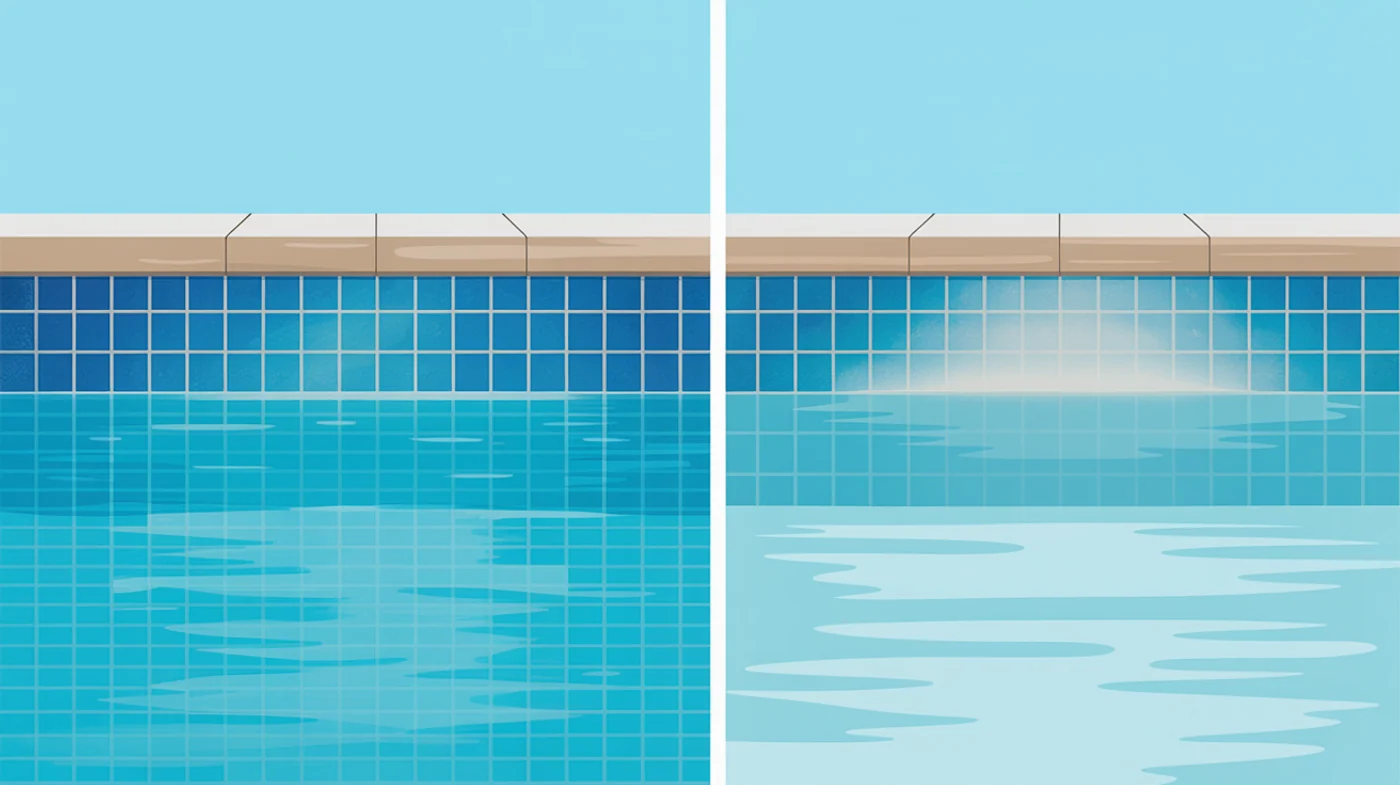
That band on your tile is calcium that left the water and hardened where it sat. In Mesa it is not bad luck — it is arithmetic.
The Mesa arithmetic
Mesa water is classed as very hard — roughly 12 to 13 grains per gallon, about 205 to 220 ppm. The target band for a plaster pool is 200 to 400 ppm. So your fill water arrives already at the bottom of the range, before a single drop has evaporated.
Then summer does the rest: water leaves, calcium stays, and you top up with more hard water. Hardness in a Mesa pool only moves one direction on its own.
- Chemistry can stop it— Keeping pH and calcium in range stops the band growing any further.
- Chemistry cannot remove it— What is already bonded to tile and plaster is mechanical work, not a product.
- Dilution is the reset— There is no chemical that takes calcium back out of water. Replacing some of it is the only route down.
Water Balance
Balanced numbers can still make unbalanced water
pH, alkalinity, calcium and temperature do not act independently. Together they decide whether your water is inclined to dissolve things or deposit them — and every reading can sit inside its own band while the combination still leans one way.
Aggressive
Water short of what it wants takes it from your pool — etching plaster, roughening surfaces and corroding metal.
Balanced
Water that neither dissolves your surfaces nor deposits onto them. This is the target, and it is a relationship between numbers rather than any single one.
Scale-forming
Water carrying more than it can hold puts the excess down — as the white line on tile, as film on surfaces, and as scale inside equipment.
This is why a technician reads the set rather than the row. A pool at the top of the calcium band with pH sitting high is heading toward deposit even though nothing is technically out of range — and catching that early is the difference between adjusting chemistry and removing scale.
Local Reality
Arizona changes the chemistry
A pool in Mesa is not a pool in Ohio with more sunshine. Six conditions here work on the water continuously, and between them they explain almost everything that goes wrong with it.
Relentless UV
Chlorine · CYA
The Sonoran sun works on your water every daylight hour. It is why stabiliser is not optional here and why an unstabilised pool cannot hold a reading through a single summer day.
95°F-plus water
Chlorine · Calcium
Hot water raises sanitiser demand, accelerates biological growth, and changes the point at which calcium comes out of solution. Summer is a different pool to the one you had in March.
Constant evaporation
Everything
Water leaves; what was dissolved in it does not. Calcium, stabiliser and total dissolved solids all concentrate in what remains — and then you top up with more hard water.
Very hard fill water
Calcium · pH
Mesa water runs about 12–13 grains per gallon — roughly 205–220 ppm — so a freshly filled pool already sits near the bottom of the recommended calcium band before anything happens to it.
Monsoon dust and debris
Chlorine · Clarity
Between 15 June and 30 September, storms deliver dust, organic debris and rain in a single afternoon. Chlorine demand spikes, and the water can go from clear to cloudy overnight.
A twelve-month season
All parameters
A Mesa pool is never closed. There is no winter shutdown during which chemistry stops mattering — only quieter months where it moves more slowly.
Monsoon dates per the National Weather Service. Water hardness per USGS and the City of Mesa.
Start With What You Can See
What does your water look like?
Each of these has chemistry causes and causes that have nothing to do with chemistry. Knowing which side you are on is what stops you buying the wrong fix.

The water is cloudy
Cloudy water is a symptom with several unrelated causes, which is why "add clarifier" so often fails. It is worth separating a chemistry cause from a filtration cause before treating it, because the two need opposite actions.
Chemistry causes
- pH drifted high
- Alkalinity too high
- Calcium saturated and coming out of solution
- Chlorine too low to keep ahead of demand
Causes that are not chemistry
- Filter media loaded or spent
- Circulation running short of a full turnover
- Very fine dust in suspension after a storm
What to test
- pH and total alkalinity
- Calcium hardness
- Free chlorine
- Filter pressure against its clean baseline
The water has gone green
Green means algae has established, which means sanitiser lost the race at some point. Clearing it takes sustained treatment plus filtration and brushing — and it is worth knowing why chlorine lost, or it will happen again.
Chemistry causes
- Free chlorine at or near zero
- Stabiliser high enough that chlorine is present but ineffective
- pH high enough to blunt the chlorine that is there
Causes that are not chemistry
- Circulation not reaching parts of the pool
- Filter not keeping up
- Heavy debris load feeding growth
What to test
- Free chlorine
- Cyanuric acid
- pH
- Whether circulation covers the whole pool
There is a white line on the tile
That band is mineral deposit — calcium that left the water and hardened onto the tile. Chemistry can stop it getting worse, but chemistry will not take it off. Removing what is already there is mechanical work.
Chemistry causes
- Calcium hardness above the recommended band
- pH persistently high
- Evaporation concentrating minerals over months
Causes that are not chemistry
- Water features and spillways accelerating evaporation locally
- A pool that has gone a long time without dilution
What to test
- Calcium hardness
- pH and total alkalinity
- Total dissolved solids
It smells strongly of chlorine
A strong chlorine smell usually means the opposite of what people assume. Well-sanitised water has very little odour; the sharp smell is generally the by-products of chlorine that has already reacted with contamination, which points to needing more effective sanitising rather than less.
Chemistry causes
- Free chlorine too low relative to demand
- pH high enough to blunt effectiveness
- Stabiliser high enough to hold chlorine back
Causes that are not chemistry
- Heavy recent swim load
- Organic contamination the pool has not caught up with
What to test
- Free chlorine
- pH
- Cyanuric acid
Chlorine will not hold
This is a stabiliser question far more often than a chlorine question. Either there is not enough to protect chlorine from the sun, or there is so much that the chlorine present cannot perform. Both look identical from the deck.
Chemistry causes
- Cyanuric acid too low for Arizona sun
- Cyanuric acid above the published maximum
- High organic demand consuming it
- pH suppressing effectiveness
Causes that are not chemistry
- Algae already established and eating it
- Circulation leaving dead zones
What to test
- Cyanuric acid — the first test, not the last
- Free chlorine
- pH
pH keeps climbing back up
Steadily rising pH is normal behaviour rather than a fault, especially in a pool with any surface agitation. The question worth answering is whether the alkalinity buffer is where it should be, because that is what decides how fast it comes back.
Chemistry causes
- Alkalinity above the target band
- Fill water carrying its own alkalinity
- Recent chemical additions pushing it up
Causes that are not chemistry
- Water features, spillways or aggressive returns driving off carbon dioxide
- A salt generator, which tends to push pH upward in normal operation
What to test
- Total alkalinity — before pH
- pH
- Fill water, tested separately from the pool
The water stings eyes or skin
Irritation is more often a balance problem than a chlorine-strength problem. Water that is too far from neutral in either direction is uncomfortable, and so is water where chlorine has been reacting with contamination.
Chemistry causes
- pH outside the recommended range in either direction
- Alkalinity too low, letting pH swing
- Free chlorine too low to keep up with demand
Causes that are not chemistry
- Heavy recent bather load
- Products carried in on skin and swimwear
What to test
- pH
- Total alkalinity
- Free chlorine
There is staining on the surface
Staining is worth diagnosing before treating, because the treatments for a metal stain and an organic stain are different and the wrong one can set the mark permanently.
Chemistry causes
- Metals in the water, often from fill water or corroding fittings
- pH low enough to have been aggressive to metal
- Organic matter left in contact with the surface
Causes that are not chemistry
- Debris left sitting on plaster
- Existing etching holding onto discolouration
What to test
- pH and total alkalinity
- Calcium hardness
- A look at the surface itself, in person
This is general guidance, not a diagnosis. The same symptom genuinely can come from several unrelated causes, and the only way to know which one is yours is to test the water and look at the equipment.
How It Is Actually Done
Measured, then corrected — in that order
Balancing without testing is guessing with a receipt. Seven steps, each of which changes what the next one should be.
Sample
Taken from elbow depth away from returns and skimmers, because a sample from the surface or next to a return is not the pool.
Test
Free chlorine, pH, total alkalinity, calcium hardness and stabiliser — the five that govern everything else.
Interpret
Read together, not one at a time. A pH reading means something different depending on what alkalinity is doing.
Correct
In order. Alkalinity, then pH, then sanitiser, with calcium and stabiliser handled as longer-term corrections.
Circulate
Nothing is corrected until it has been distributed. Chemistry added to a pool that is not turning over is chemistry sitting in one place.
Retest
Confirm the correction landed where it was supposed to, rather than assuming the dose did what the label said.
Document
Recorded so the trend is visible. Single readings are noise; the direction a number is heading is the actual information.
Salt Pools
Salt water is not chemistry-free
A salt system does not remove the need for chlorine — it manufactures it. Everything on this page still applies, and one or two things apply harder.
We test and balance salt pools the same way we do any other. Salt cell replacement and generator repair are not services we list, so if the hardware itself is the problem we will say so rather than quote for it.
It is still a chlorine pool
A salt system does not replace chlorine — it manufactures it, continuously, from the salt already dissolved in the water. Everything true of chlorine chemistry is still true here.
pH tends to climb
Salt generators typically push pH upward during normal operation. On a Mesa pool that is already drifting up from evaporation and agitation, the two effects add together.
Stabiliser still matters
Generated chlorine is just as vulnerable to Arizona sun as chlorine from a jug. A salt pool with no stabiliser loses what it makes.
Hard water is hard on cells
Mesa’s calcium scales the cell surfaces, and 95°F-plus water strains the generator. Salt cells are a wear item in this climate rather than a fit-and-forget component.
Cleaning, Balancing Or Maintenance?
Three different jobs that get confused constantly
Cleaning is the physical work. Balancing is the water. Maintenance is both, on a schedule.
The physical work
Pool cleaning
- Skimming the surface
- Brushing walls and steps
- Vacuuming the floor
- Emptying skimmer and pump baskets
- Clearing debris
The water itself
Chemical balancingyou are here
- Testing the five core numbers
- Correcting sanitiser
- Correcting pH and alkalinity
- Tracking calcium and stabiliser
- Deciding when dilution is due
Both, on a schedule
Pool maintenance
- Water tested and balanced every visit
- Physical cleaning
- Filter pressure read and acted on
- Equipment checked before it fails
- Documented service notes
Being Straight About It
When balancing alone will not fix it
Chemistry is sometimes the symptom rather than the problem. Five situations where more product is the wrong purchase.
Stabiliser or dissolved solids have saturated the water
Neither can be removed chemically. Once they are past the published limits, no dose brings them back — the water itself has to be partly replaced.
Pool drainingCalcium has already hardened onto surfaces
Correct chemistry stops the deposit growing, but it does not lift what is already bonded to tile and plaster. That is mechanical work.
Acid washThe pool is green, not just unbalanced
Established algae needs sustained treatment plus filtration and repeated brushing. Chemistry alone, without the physical work, tends to stall.
Pool cleaningChemistry is correct and the water still will not clear
If the numbers are right, look at whether the water is actually moving. A loaded filter, a failing pump or a restricted line means treated water never reaches the whole pool.
Pool repairThe filter no longer recovers after a clean
Media that will not return to its clean baseline is spent. Until it is replaced, clarity problems will keep being blamed on chemistry.
Filter installation
The Arizona Year
What changes, and when
A Mesa pool never closes. The work does not stop — it just changes shape five times a year.
Spring
March – May
Demand wakes up faster than most people expect.
Water temperature climbs quickly and sanitiser demand climbs with it. This is when a pool that coasted through winter suddenly cannot hold a chlorine reading, and when algae gets its first real opportunity of the year.
Summer
June – September
Peak UV, peak heat, peak evaporation — all at once.
Chlorine burns off fastest, demand is highest, and evaporation is concentrating calcium and stabiliser in the water that stays behind. Everything that was slowly drifting now moves weekly.
Monsoon
15 June – 30 September
A single storm can undo a week of balance.
Dust and organic debris arrive in volume, rain dilutes some parameters while loading others, and chlorine demand spikes overnight. The National Weather Service fixes the season to these dates regardless of when the first storm lands.
Autumn
October – November
The best window of the year for the big corrections.
Demand falls off, the pool is calmer, and the numbers finally hold still long enough to act on. If stabiliser or calcium has climbed past where it should be, this is the comfortable time to deal with it rather than in July.
Winter
December – February
Quieter, but never off.
Sanitiser demand drops a long way. Evaporation does not stop, though, so calcium and dissolved solids keep concentrating quietly — a Mesa pool left entirely alone over winter is still changing.
Answers
Pool chemistry questions, answered
Grouped by what you are actually dealing with. These are the questions Arizona pool owners search for most.
Chlorine
Why does my chlorine disappear so fast in Arizona?
Almost always ultraviolet light plus a stabiliser level that is wrong in one direction or the other. Unstabilised chlorine can be largely destroyed by a single day of direct Arizona sun. Cyanuric acid slows that down dramatically — but above the published maximum of 100 ppm the chlorine you have becomes less effective for the amount present, so the pool behaves as though it is under-chlorinated even when the reading looks fine. Test stabiliser before adding more chlorine.
What free chlorine level should a pool hold?
The CDC recommends a free chlorine concentration of at least 1 ppm in pools, and at least 2 ppm where cyanuric acid is present. Most residential pools are run somewhat above that minimum so there is capacity in reserve for a hot day or a heavy weekend, rather than sitting exactly on the floor of the recommendation.
Why does my pool smell so strongly of chlorine?
Usually because it needs more effective sanitising, not less. Well-sanitised water has very little smell. The sharp chlorine odour generally comes from the by-products formed when chlorine reacts with contamination — so a strong smell often accompanies a pool that is struggling to keep up, not one that is over-treated.
Will shocking the pool fix it?
It treats the symptom. Shock raises sanitiser sharply and will often clear a specific event, but if chlorine could not hold before, it will not hold afterwards either. It is worth establishing why the level failed — stabiliser, demand, pH or circulation — otherwise you are buying the same fix repeatedly.
pH & alkalinity
Why does my pool pH keep rising?
Rising pH is normal desert behaviour rather than a fault. Surface agitation — water features, spillways, aggressive returns, even wind — drives dissolved carbon dioxide out of the water, and pH climbs as it goes. Salt generators tend to push it upward too. What decides how fast it comes back is total alkalinity, so that is the number to check first.
What pH should a pool be kept at?
The CDC gives an acceptable range of 7.0 to 7.8, and explains the trade-off directly: as pH rises, chlorine gets worse at killing germs; as it falls, chlorine works better but pipes and surfaces are more likely to corrode. The Pool & Hot Tub Alliance target most technicians balance toward sits at 7.4 to 7.6, in the middle of that band.
What causes low alkalinity in a pool, and does it matter?
It matters more than most homeowners expect, because alkalinity is what holds pH steady. Low alkalinity comes from acidic additions, rain dilution and simply not having been corrected in a while. The symptom is unmistakable: pH that will not stay put no matter what you add. ANSI/APSP-11 puts the acceptable band at 60 to 180 ppm, with 80 to 120 ppm the usual working target for a chlorinated pool.
What order should pool chemicals be corrected in?
Alkalinity first, then pH, then sanitiser, with calcium hardness and stabiliser treated as longer-term corrections. Chasing pH before the buffer is right is the single most common reason home dosing never seems to hold — you are correcting the number that the unfixed one controls.
Calcium & scale
What causes the white line on my pool tile?
Calcium leaving the water and hardening onto the tile, driven by high calcium hardness together with high pH. Arizona makes it worse mechanically: as water evaporates the dissolved calcium stays behind and concentrates in what is left. Correct chemistry stops the band growing, but removing what has already formed is mechanical work rather than something a chemical does.
Does Mesa hard water really affect my pool?
Yes, and it starts before you have done anything. Mesa water is classed as very hard at roughly 12 to 13 grains per gallon — about 205 to 220 ppm — which puts a freshly filled pool near the bottom of the 200 to 400 ppm band that PHTA targets for plaster pools. Every gallon that evaporates afterwards concentrates it further, and every top-up adds more.
Can unbalanced water damage my equipment?
It can, in both directions. Water low in calcium or pH is aggressive and corrodes metal and heat-exchange surfaces. Water saturated with calcium deposits scale inside plumbing and on those same surfaces, quietly restricting flow until the equipment is working harder than it should. Neither shows up quickly, which is exactly why the trend matters more than any single reading.
What happens if calcium hardness is too low?
Water short of calcium takes it from wherever it can, which on a plaster pool means the surface itself. That shows up as etching and a rough, chalky feel underfoot, and it does not grow back — the finish has to be repaired. PHTA gives 150 ppm as the acceptable minimum and 200 to 400 ppm as the target for concrete and plaster pools.
Stabiliser (CYA)
What does stabiliser actually do?
Cyanuric acid shields chlorine from ultraviolet light, so the chlorine survives long enough to sanitise instead of being destroyed by the sun. In Arizona that is not a refinement — without it, a pool can lose most of its chlorine in a single day of direct summer sun.
What causes cyanuric acid to get too high?
Two things, and they compound. Stabilised chlorine products add cyanuric acid with every dose, so a pool run on tablets accumulates it continuously. And because cyanuric acid neither evaporates nor gets consumed, evaporation concentrates what is already there. A Mesa pool on tablets climbs toward the ceiling year after year unless water is replaced.
How do I lower cyanuric acid in my pool?
By dilution — replacing some of the water with fresh. There is no practical chemical that removes it. That is why watching the trend matters: catching it while it is climbing means a planned partial drain, whereas discovering it at the ceiling in July means doing the same job in the worst conditions of the year.
What level should stabiliser be kept at?
ANSI/APSP-11 sets a maximum of 100 ppm, with 30 to 50 ppm the usual ideal. Arizona pools genuinely need to be in that range rather than at zero — the mistake here is not having stabiliser, it is letting it accumulate unwatched until the chlorine stops performing.
Cloudy & green water
Why is my pool cloudy even when the chemicals look fine?
Because cloudiness has causes on both sides of the equipment pad. If chlorine, pH and alkalinity genuinely read in range, the next question is whether the water is being filtered properly — a loaded or spent filter, or a pool not achieving a full turnover, leaves fine particles in suspension that no chemical addresses. Check filter pressure against its clean baseline before adding anything else.
How does monsoon weather affect pool chemistry?
A single storm between 15 June and 30 September can undo a week of balance. Dust and organic debris arrive in volume and consume sanitiser on contact, rain dilutes some parameters while the debris load spikes others, and the water can go from clear to cloudy overnight. The chemistry problem after a storm is usually demand, not dosing.
Can water get so far out of balance that it cannot be corrected?
Yes. When dissolved solids or stabiliser climb high enough, no amount of chemical addition brings the water back, because the problem is what is already dissolved in it. Dilution is the only remedy, which means a partial or full drain and refill. Steady testing is what keeps a pool from quietly reaching that point.
Salt pools
Do salt water pools still need chemicals?
Yes. A salt system makes chlorine from the salt in the water rather than removing the need for it, so the water is still a chlorinated pool. pH, alkalinity, calcium and stabiliser all still need testing and correcting — and salt generators tend to push pH upward, which in Arizona adds to a pool that is already drifting that way.
Is a salt pool easier to look after in Arizona?
Less hands-on dosing, not less maintenance. Chlorine levels stay steadier because the generator produces continuously, but the water still needs weekly testing and Arizona is hard on the hardware — hard water scales the cell and high summer water temperatures strain the generator, making cells a periodic replacement item rather than a fit-and-forget part.
Service
How often should pool water be tested?
Weekly is the practical rhythm for a Mesa pool, and more often through summer or after a monsoon storm, because that is how fast things actually move here. Chemistry in this climate is not a monthly job — UV, heat and evaporation all work on the water continuously.
Is chemical balancing included in a regular service?
Testing and balancing the water is part of every clean and every maintenance visit — chlorine, pH and alkalinity read and corrected, with calcium and stabiliser tracked over time. If your pool needs a larger chemical treatment or a specialty product, we tell you what it needs and what it costs before doing it. Ask how chemical cost works for your specific pool when you get your estimate.
Can I just get the water tested without a full service?
Tell us what the pool is doing and we will work out what it needs. The most useful thing we can do on a first visit is look at the actual water and the actual equipment, because a symptom like cloudy or green water genuinely can come from either side, and treating the wrong one is what wastes money.
Where We Work
Water testing across the East Valley
Same chemistry, slightly different pressures depending on where your pool is.
Have the water tested properly
Tell us what your pool is doing. We test before treating, correct in the order that actually holds, and say plainly when the answer is water rather than chemicals.