
Filter Installation · Mesa & the East Valley
Arizona Throws A Lot
At Your Pool.
Dust, monsoon debris, pollen, oils and dead algae all end up in the same place — the filter. Which one you have, how big it is, and how you read its gauge decide whether that is a weekly chore or a solved problem.
- Sized to the system
- Plumbed to be serviced
- Baseline pressure recorded
Pool filter installation is replacing a failing or undersized filter with one matched to your pump's flow, your pool's volume and the debris the pool actually deals with — then plumbing it so it can be serviced, commissioning it under real flow, and recording the clean-filter pressure so you know what "needs cleaning" looks like on your own gauge.
The Desert Load
What your filter is actually catching
Six things, and only two of them are the leaves everyone pictures. The fine stuff is what separates one filter type from another.

Fine desert dust
The signature Arizona load. It is small, it is constant, and it is the particle size that separates the three filter types more than anything else does. This is why a filter that is fine on paper still needs cleaning often here.
Monsoon debris
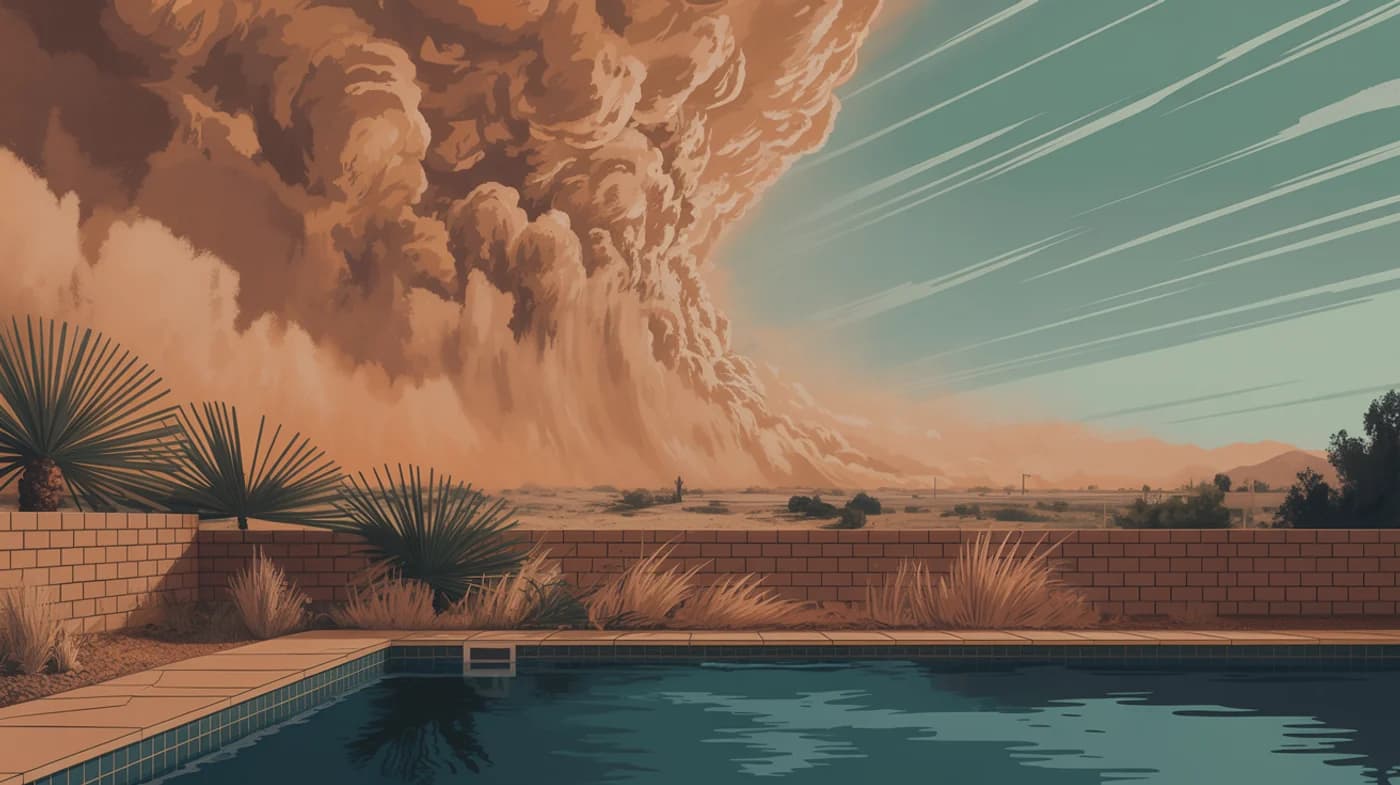
Between 15 June and 30 September a single storm delivers in an afternoon what a filter would normally see in weeks — dust, leaves, palm litter and grit, all at once.
Pollen and organics
Seasonal, fine, and biologically active. Organic load consumes sanitiser as well as loading the filter, which is why cloudy water after a bloom is rarely one problem.
Sunscreen and body oils
A long swim season means a long oil season. Oils blind filter media in a way rinsing does not always fix, which is why cartridges need a periodic deep clean rather than only a hose-down.
Dead algae
After treating a green pool, the algae does not disappear — it becomes very fine suspended particulate the filter now has to remove. Expect pressure to climb fast in the days after a treatment.
Scale on the media
Mesa water is very hard, roughly 12 to 13 grains per gallon. Minerals deposit on filter surfaces over time and are not removed by rinsing, which shortens how well an element recovers.
Why the water is this hard here
Inside The Tank
Three ways to catch it
Cartridge, sand and DE do the same job by genuinely different means — and the difference in how you live with them is bigger than the difference in what they catch.
Cartridge filter
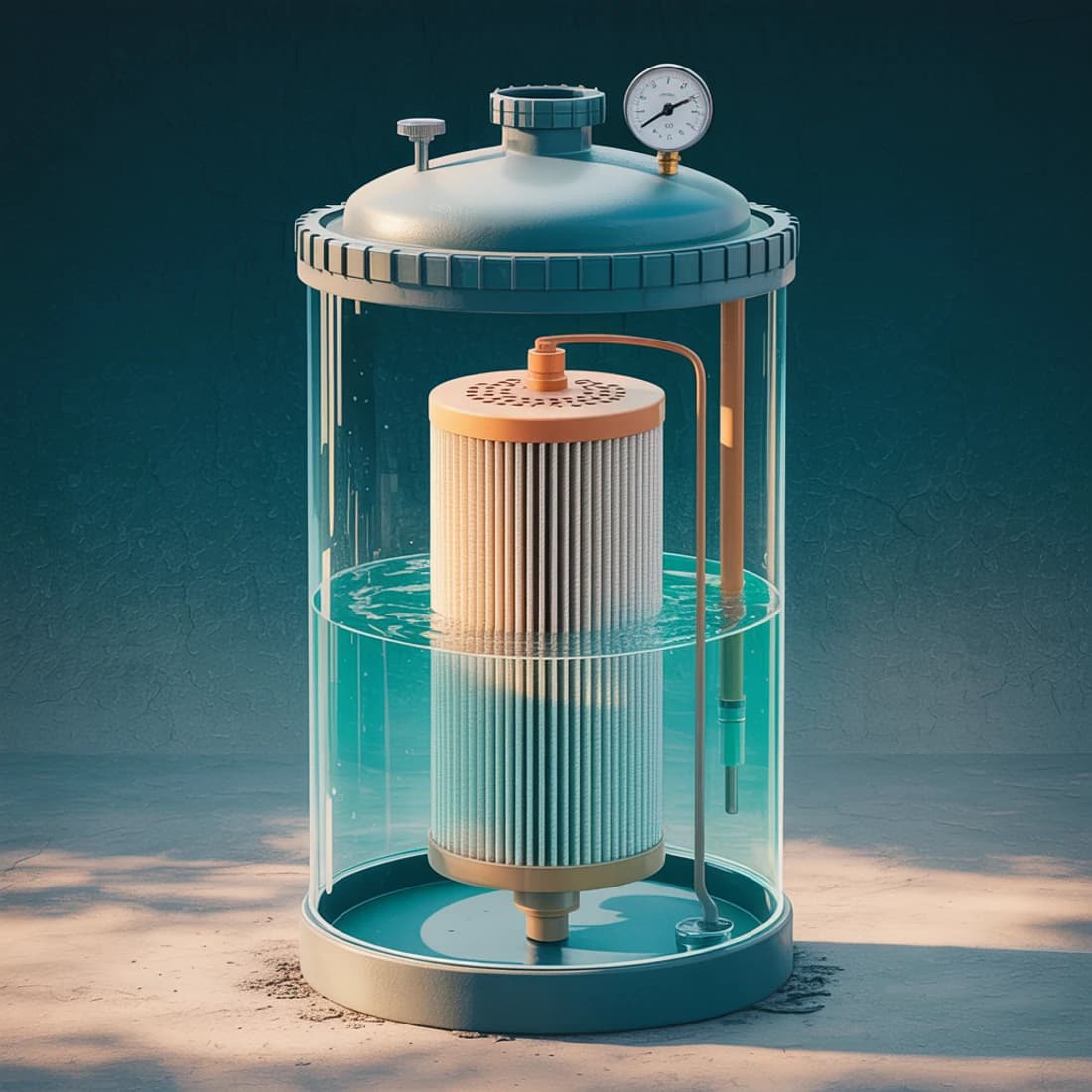
Dirty water enters low in the tank and fills it. It is then pushed inward through the pleated element from the outside, leaving debris on the outer face of the pleats. Clean water collects in the element’s hollow core and leaves through the outlet beneath it.
What you are looking at
- 1Air relief valve — purges trapped air on start-up
- 2Pressure gauge — read against your clean baseline
- 3Clamp band — releases the lid to reach the element
- 4Element top cap and hollow core — filtered water collects here
- 5Pleated element — the media; debris collects on the outside
- 6Outlet beneath the core — clean water back to the pool
Sand filter
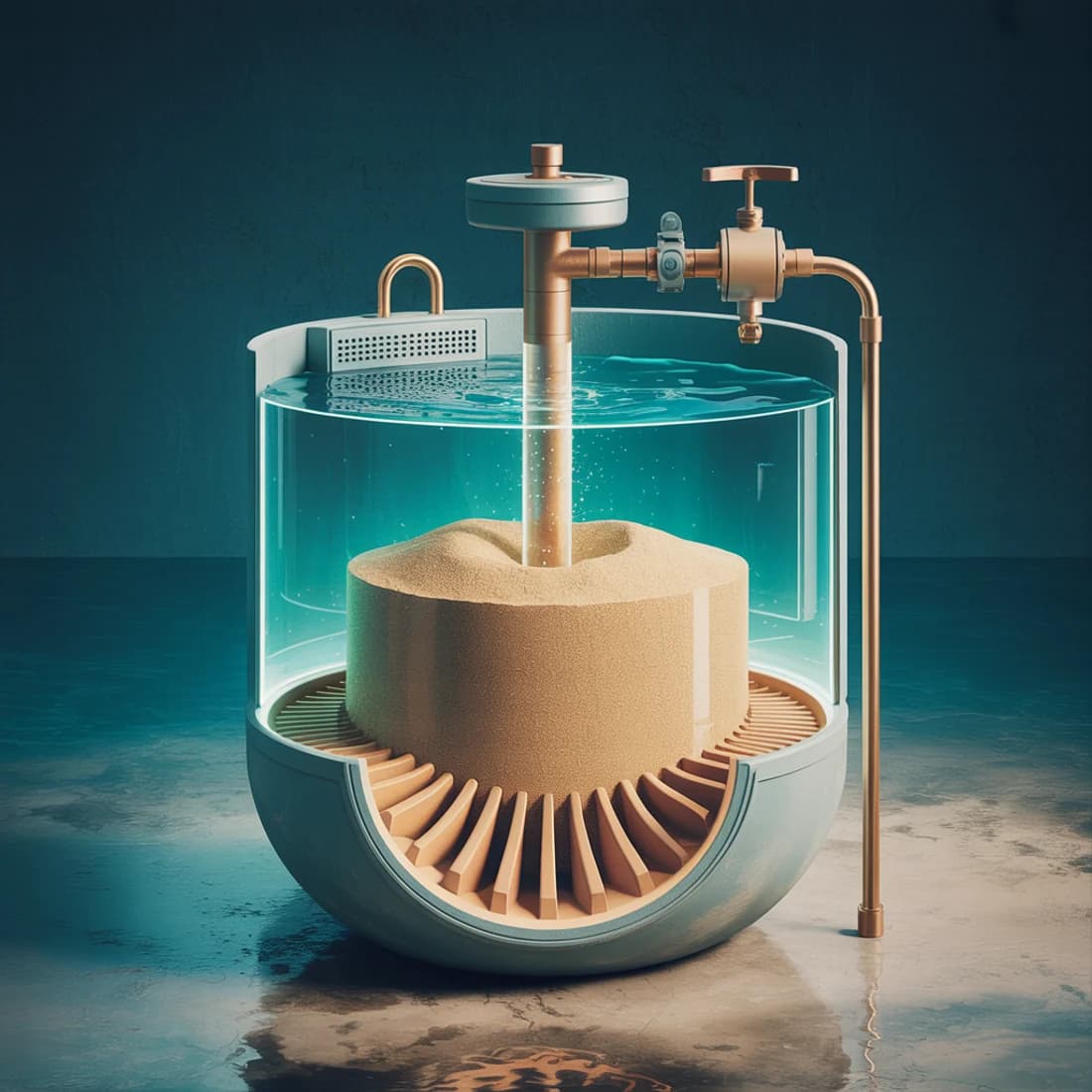
Water enters at the top and is spread across the bed by the diffuser. It travels down through the sand, which traps debris between the grains. Filtered water is collected by the laterals at the base, rises back up the standpipe, and leaves through the multiport valve. Backwashing reverses that path to flush the bed to waste.
What you are looking at
- 1Multiport valve — selects filter, backwash, rinse or waste
- 2Diffuser — spreads incoming water across the bed
- 3Standpipe — carries filtered water back up the centre
- 4Sand bed — the media that does the filtering
- 5Laterals — slotted arms that collect water and hold the sand back
- 6Waste line — where backwash water goes, and it must go somewhere legal
DE filter
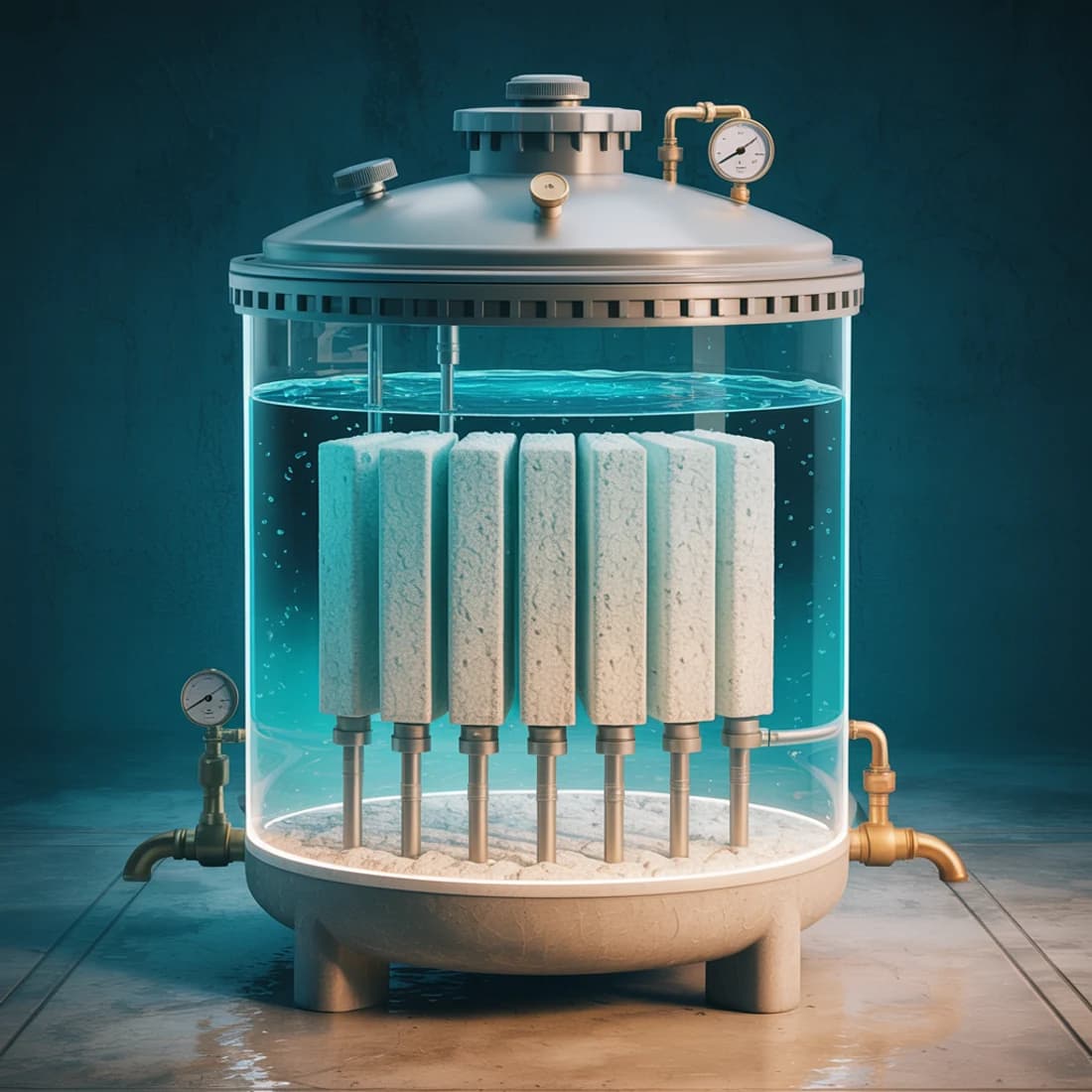
The grids inside are coated with diatomaceous earth powder, and that coating is what actually filters. Water is pushed through the coated grid fabric from the outside, the powder captures very fine particles, and filtered water is collected inside the grids and carried out through the bottom manifold.
What you are looking at
- 1Air relief valve
- 2Pressure gauge
- 3Clamp band — releases the lid to reach the grids
- 4Grids coated in DE powder — the powder is the filter medium
- 5Manifold — collects filtered water from every grid
- 6Outlet and backwash connection
Side By Side
Which one suits your pool?
There is no universally best filter. There is a best filter for your pump, your debris load and how much routine you will actually do.
| CartridgePleated elements, no backwashing | SandA media bed, cleaned by backwashing | DE (diatomaceous earth)The finest filtration, the most involved care | |
|---|---|---|---|
| Filtration finenessOrdering is well established; exact micron figures are not — see the note below the table. | Finer than sand, coarser than DE | The coarsest of the three | The finest of the three, clearly |
| How you clean it | Pull the elements and hose them down | Flip the valve and backwash | Backwash, then recharge powder; strip the grids periodically |
| Backwashing | None | Every cleaning cycle | Every cleaning cycle |
| Water used to cleanThe row that matters most in a desert city. | Hose water only — no pool water to waste | Pool water to waste every backwash | Pool water to waste every backwash, carrying spent media |
| Routine effort | Moderate and hands-on | Lowest | Highest |
| Consumables | Elements, replaced when they stop recovering | Media, replaced infrequently | DE powder after every backwash; grids over time |
| Fine desert dust | Holds it, at the cost of more frequent cleaning | Passes the finest of it | Captures it best |
| Bulk monsoon debris | Loads quickly; needs attention after a storm | Most forgiving | Copes, but recharging after each backwash adds up |
| Low-speed / variable-speed pumps | Well suited — low resistance when clean | Works, but needs enough flow to backwash properly | Works, with attention to flow through the grids |
| Disposal question | Rinse water only | Backwash needs a legal discharge point | Backwash with spent media needs a legal discharge point |
On micron ratings: you will find confident numbers online, and they disagree with each other — published figures for the same filter type vary substantially between reputable sources, and real performance shifts with flow rate, media condition and how loaded the filter already is. The ordering is not in dispute: DE is finest, cartridge is in the middle, sand is coarsest. We would rather give you the ordering that is true than a decimal place that is not.
Cartridge
Water passes through pleated fabric elements held inside a tank. The pleats give a large surface area in a small footprint, and when they load up you take them out and rinse them rather than reversing flow through the tank.
In the desert
Fine dust loads the pleats steadily, so expect more cleans through monsoon season than a brochure suggests. The upside is that a loaded cartridge tells you honestly — pressure climbs and you can look at the element.
Suits: Most Mesa back yards, and particularly anyone running a variable-speed pump or who would rather not send pool water down a drain every few weeks.
Sand
Water is pushed down through a bed of filter sand, which traps debris between the grains. Cleaning is done by reversing the flow — backwashing — which lifts the bed and flushes the trapped material out to waste.
In the desert
Copes well with the bulk debris a monsoon delivers, but very fine desert dust is exactly the particle size a sand bed is least good at holding onto.
Suits: Owners who want the least hands-on routine and can accept coarser filtration, or pools that regularly take on heavy debris.
DE (diatomaceous earth)
Fabric-covered grids inside the tank are coated with diatomaceous earth powder, and that powder does the filtering. It captures the smallest particles of the three by a clear margin.
In the desert
The best answer to fine desert dust on filtration grounds alone. Whether it is the right answer depends entirely on whether the routine actually gets done.
Suits: Owners who genuinely want the clearest possible water and will keep up with the routine — or will pay someone to.
Read Your Gauge
Your gauge needs a baseline
The most common question about pool filters — "what pressure should it run at?" — has no universal answer. The number that matters is how far it has moved from where your filter reads clean.
Your clean baseline
The pressure the gauge reads with a genuinely clean filter, right after installation or a full clean.
What to do: Write it on the tank in permanent marker. It is the single most useful number on your equipment pad, and it is different for every pool.
Normal operating range
Pressure sits a little above baseline and climbs slowly as the filter does its job. This is the filter working, not failing.
What to do: Nothing. A filter that never loads is a filter that is not catching anything.
Meaningfully above baseline
Flow is being restricted by what the media is holding. Returns weaken and the pump works harder for less water movement.
What to do: Time to clean or backwash. Go by the rise over YOUR baseline, not by a number off the internet.
Will not return to baseline
You have cleaned it and the pressure still sits high. The media is no longer recovering.
What to do: This is the replacement signal. Cleaning it again will not fix media that is spent, blinded or scaled.
Pressure has dropped
Lower than baseline usually means less water is arriving at the filter, so the restriction is upstream.
What to do: Look before the filter: baskets, water level, suction-side air, the pump itself.
Sizing
Bigger filter, less fighting
Pool volume is where sizing starts, not where it ends. Six things decide it, and surface area is the one that changes your weekends.
Pool volume
The starting point, but only the starting point. Volume tells you how much water has to move; it does not tell you how fast the rest of the system can move it.
Pump flow
A filter has a design flow limit. Pushing more water through it than it is rated for does not filter faster — it filters worse, because water passes the media too quickly to be caught properly.
Filter surface area
More area means the same amount of dirt is spread thinner, so pressure climbs more slowly and the gaps between cleans get longer. This is the number that actually changes your weekends.
Plumbing
Pipe diameter and the run between equipment set a ceiling on flow regardless of what the pump and filter are rated for. A bigger filter cannot fix a restricted pipe.
Debris load
Two identical pools in Mesa can need different filters. Trees overhead, an exposed lot, a wind-facing yard — these change how fast the filter loads far more than pool size does.
How you run the pump
A variable-speed pump running long and slow puts a different demand on a filter than a single-speed running hard for a few hours. The filter has to suit how the system is actually operated.
Signs yours is too small
- Cleaning it far more often than feels reasonable
- Pressure climbing back within days of a clean
- Water clarity that never quite gets there despite correct chemistry
- Filter loading noticeably faster after a pump upgrade
- Returns that weaken quickly between services
Oversizing a filter is a far smaller problem than undersizing one — in a dusty climate, extra surface area mostly buys longer gaps between cleanings. The real limits are the pump's flow, the plumbing, and what physically fits on the pad.
Check my filter sizeTroubleshooting
What your filter is telling you
Six things filters actually do when something is wrong — and which of them mean replace rather than clean.
Pressure climbs fast after cleaning
A filter that loads back up within days of a clean is telling you the load is beating the capacity. Either something is putting far more into the water than usual, or the filter is too small for what this pool actually deals with.
If chemistry is the real loadLikely causes
- Heavy dust or debris load, especially post-monsoon
- Dead algae still suspended after a treatment
- Media that is blinded by oils or scale and only partly cleaned
- A filter genuinely undersized for the pool and its conditions
What we check
- Baseline pressure versus current, on your own gauge
- The condition of the media itself, in hand
- Filter capacity against the pump and pool volume
- Whether water chemistry is loading the filter
Pressure never returns to baseline
This is the clearest replacement signal there is. Media that has been properly cleaned and still will not return to its clean-filter pressure has stopped being able to.
Likely causes
- Cartridge fibres worn or permanently blinded
- Oils absorbed into the element beyond what rinsing removes
- Mineral scale on the media from hard water
- Sand media that has channelled or hardened
What we check
- Whether a proper deep clean recovers it at all
- Physical condition of elements, grids or media bed
- Age and service history
- Whether replacing like-for-like is right, or the size should change
Dirt is coming back into the pool
Debris arriving through the returns means water is getting past the media rather than through it. That is a bypass, and it does not fix itself.
Diagnosis before replacementLikely causes
- A torn cartridge element or damaged DE grid
- A failed internal seal or clamp letting water route around the media
- On sand systems, a cracked lateral or standpipe
- A multiport valve passing water where it should not
What we check
- Internals, in person — this one genuinely cannot be diagnosed from the deck
- Seals, clamps and manifolds
- Whether the media itself is intact
- Valve condition and position
The filter is leaking
Where it leaks from matters more than the fact that it leaks. A clamp-band or o-ring drip is routine; a leak from the tank body itself is a different conversation.
Leak diagnosisLikely causes
- Perished clamp-band or lid o-ring
- A drain plug or air-relief assembly past its best
- Fittings loosened by heat cycling
- A cracked tank — which is a replacement, not a repair
What we check
- Exact leak origin under running pressure
- Seal condition
- Tank body integrity
- Whether parts are still available for the unit
Water is cloudy but the filter seems fine
Cloudy water is not automatically a filter problem. Clear water needs three things working together — flow, filtration and chemistry — and cloudiness only tells you one of them has failed, not which.
Start with the water chemistryLikely causes
- Chemistry out of balance, especially pH and alkalinity high
- Insufficient run time to actually turn the water over
- Filter media past its useful life
- Very fine particulate the media cannot hold
What we check
- Filter pressure against baseline
- The five water chemistry numbers
- Whether circulation is reaching the whole pool
- Media condition
The returns feel weak
Weak returns mean the water is not turning over, and the filter is only one of the places that can be restricting it. Whether the gauge reads high or low tells you which side of the pump to look at.
When the pump is the causeLikely causes
- Filter loaded and restricting flow — pressure reads HIGH
- Blocked baskets or a suction-side restriction — pressure reads LOW
- Air being drawn in before the pump
- A pump that is no longer moving what it should
What we check
- Gauge reading against baseline
- Baskets and suction path
- Whether the pump is holding prime
- Valve positions
The Honest Version
Clean it, replace it — or neither
Plenty of filters get replaced when they needed a clean, and plenty get cleaned forever when the media was finished.
Clean it
- Pressure returns to baseline after cleaning and stays there
- Elements or media are physically intact
- The tank and clamp are sound
- Water clears normally once the filter is clean
Replace it
- Pressure will not return to baseline after a proper clean
- Elements are torn, or grids are damaged
- The tank body is cracked
- Parts are no longer available for the unit
- The filter is genuinely undersized for the system as it now runs
Neither — it's not the filter
Chemistry is the actual load
Chemical balancingThe pump is not delivering flow
Pool repairDebris is overwhelming the system
Pool cleaningThe whole pad is due
Equipment installation
The Mental Model
Clear water needs three things
A new filter fixes exactly one of them. Knowing which leg has failed is what stops you buying the wrong thing.
Flow
Water has to actually move through the system. No flow means the other two never get their turn.
Pump and circulation problemsFiltration
Whatever is suspended has to be physically removed. This is the filter’s entire job.
Chemistry
Sanitiser and balance stop new growth and keep what is dissolved from coming out of solution.
The five core numbers
15 June – 30 September
One storm, a season's worth of debris
A monsoon afternoon delivers what a filter would normally handle over weeks — dust, palm litter, grit and organic matter, all at once. Pressure jumps, clarity drops, and the filter is doing its job rather than failing.
Before
Pressure sits near baseline. Nothing to do.
During
Debris arrives in volume, and organic load starts consuming sanitiser as well as loading media.
After
Pressure jumps and water can go cloudy overnight. Baskets fill faster than usual.
Recovery
Clear the baskets, let the filter be cleaned once it has climbed over baseline, then check the water chemistry — a storm loads both.
Leave the pressurised tank alone. Opening a filter that is still under pressure is one of the few genuinely dangerous things on a pool pad — the system has to be off and the air relief opened first, and if you are not certain, that is what we are for.
How We Install One
Ten steps, and two of them are the point
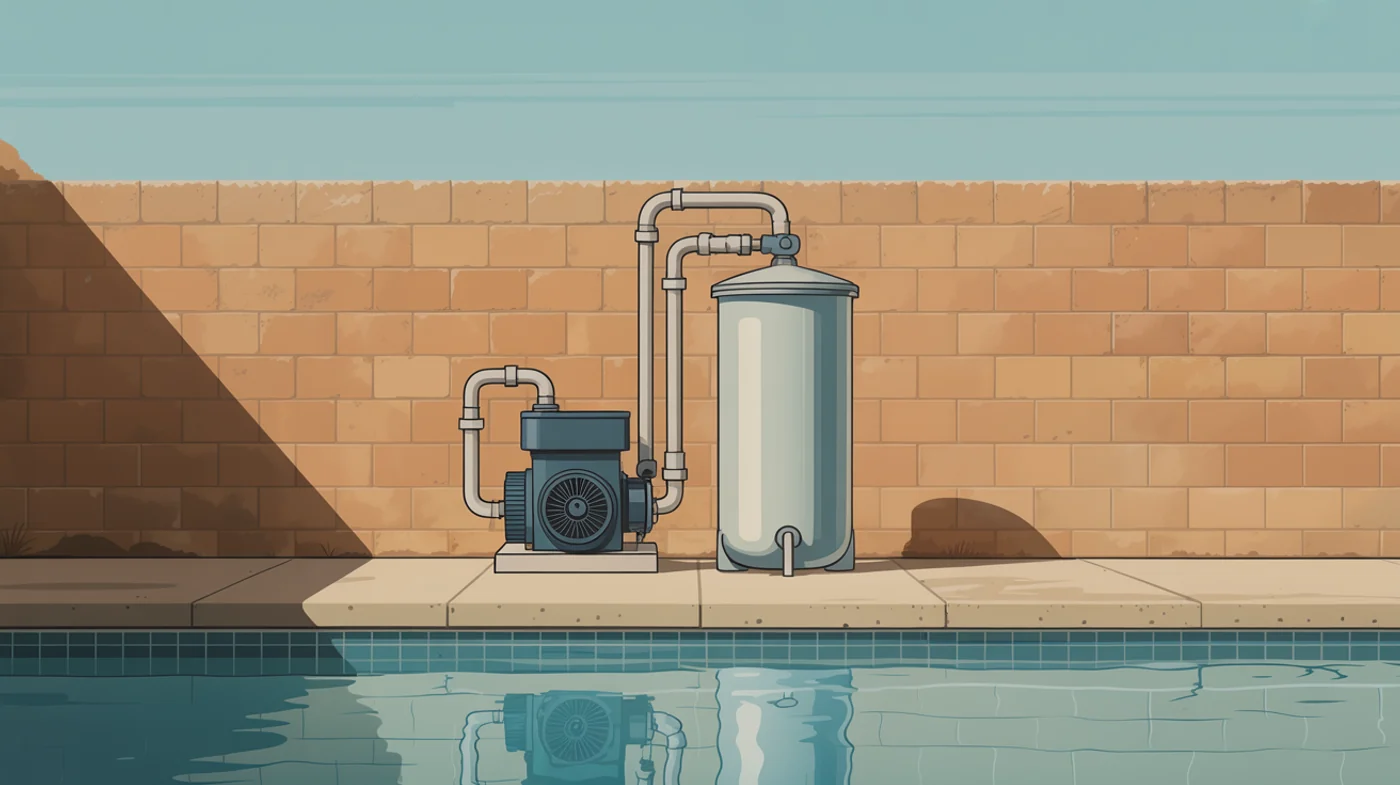
Plumbing it so it can be opened again, and handing you the baseline pressure. Those are the two that decide what owning it feels like.
- 01
Audit the system
Pump, plumbing, pool volume and how the pool is actually used and run — before anything is specified.
- 02
Match capacity to flow
Filter sized to the pump and the pool, not to whatever the old unit happened to be.
- 03
Choose the type honestly
Cartridge, sand or DE, chosen against how you want to live with it — not against a preference of ours.
- 04
Remove the old unit
Old tank out, existing plumbing assessed rather than assumed.
- 05
Plumb for service
Connections made so the unit can be opened and serviced later without cutting pipe every single time.
- 06
Install and seal
Tank set with the clearance it needs to actually be opened, and sealed properly.
- 07
Start and purge air
System started, air relieved, and the filter brought up under real operating conditions.
- 08
Check for leaks
Under running pressure, not by eye on a static tank.
- 09
Record the baseline
Clean-filter pressure read and written on the tank, so you own the one number that tells you when to clean it.
- 10
Walk you through it
How to clean it, what the gauge means, and what "needs attention" looks like on your specific system.
Answers
Pool filter questions, answered
Grouped by what you are actually trying to decide.
Choosing
Which pool filter is best for an Arizona pool?
There is no single right answer, and anyone who gives you one without looking at your pool is guessing. DE filters the finest, which suits Arizona’s very fine dust. Cartridge is the middle ground and does not backwash, which matters where water is metered and waste is restricted. Sand is the least hands-on but the coarsest, and it costs water every time you clean it. The right pick depends on your pump, your debris load, and honestly how much routine you will actually do.
Do you backwash a cartridge filter?
No — and that is one of the main reasons people choose one. A cartridge filter is cleaned by removing the elements and rinsing them, so it never sends pool water to waste the way a sand or DE backwash does. In a desert city that is a meaningful ongoing difference rather than a technicality.
What are the downsides of a cartridge filter?
The cleaning is manual, so it takes longer than flipping a valve, and heavy dust means doing it more often. The elements are a consumable — eventually they stop recovering after a clean and have to be replaced. And oils from sunscreen can blind the fabric in a way a quick hose-down will not fix, so they need a proper deep clean periodically.
What are the downsides of a sand filter?
It is the coarsest of the three, so the very fine dust Arizona specialises in is exactly what it is least good at holding. Every cleaning cycle sends pool water to waste, which costs water and needs somewhere legal to go. On the other side, it is genuinely the least work to live with, and it handles bulk storm debris better than the others.
Is a DE filter worth it?
It gives the finest filtration available on a residential pool by a clear margin, so if water clarity is what you care most about, it delivers. The cost is routine: it backwashes, and after every backwash it has to be recharged with fresh powder, plus the grids need stripping periodically. It is worth it for people who will keep up with that — or who are paying someone to.
Can a pool filter be too big?
Oversizing a filter is a much smaller problem than undersizing one, and in a dusty climate extra surface area mostly buys you longer gaps between cleanings. The real constraint is the rest of the system: the filter has to suit the pump’s flow and the plumbing that feeds it, and there is a practical limit to what fits and can be serviced on the pad.
Sizing
What size pool filter do I need?
Pool volume is where sizing starts, not where it ends. The filter has to suit the pump’s flow rate, the plumbing that feeds it, and the debris load the pool actually sees — which in Mesa varies enormously between a sheltered yard and an exposed lot. Surface area is the number that decides how often you will be cleaning it, so it is usually the one worth spending on.
What happens if a pool filter is undersized?
It loads up fast and never gets ahead. You clean it far more often than feels reasonable, pressure climbs back within days, flow is restricted so the pump works harder for less water movement, and clarity never quite arrives even when the chemistry is right. It is one of the most common reasons a pool feels like constant work.
Should I replace the filter at the same time as the pump?
Worth considering, because the two work as a system and a new pump changes what the filter sees. A more capable pump pushing more water through an already-marginal filter tends to expose the filter’s limits immediately. It is not automatic though — if the existing filter is healthy and correctly sized for the new flow, there is no reason to replace it.
Pressure
What pressure should my pool filter run at?
There is no single correct psi for every pool, and any number quoted without knowing your system is meaningless. The useful reference is your own clean-filter baseline — the reading with a genuinely clean filter on your equipment. What matters is how far above that it has climbed, not the absolute figure. Write your baseline on the tank; it is the most useful number on the pad.
Is 20 or 25 psi too high for a pool filter?
It depends entirely on what that filter reads clean. A system with a 10 psi clean baseline sitting at 25 is heavily loaded; a system that reads 20 clean is barely working at 25. This is exactly why the baseline matters more than the number — the same reading means opposite things on two different pools.
Why does my filter pressure keep rising?
Rising pressure is the filter doing its job — it climbs as the media collects what it is supposed to collect. It becomes a problem when it climbs unusually fast, or will not come back down after cleaning. Fast climbing points to a heavy load, dead algae after a treatment, or a filter undersized for the pool. Not coming back down points to media that is spent, blinded by oils, or scaled by hard water.
Why is my filter pressure low?
Low pressure usually means less water is reaching the filter, so the restriction sits before it rather than in it. Blocked skimmer or pump baskets, a low water level, air being drawn in on the suction side, or a pump that is not moving what it should. Reading the gauge as high-versus-low is the quickest way to tell which side of the pump to investigate.
Problems
Why is dirt coming back into my pool?
Debris coming out of the returns means water is bypassing the media rather than passing through it. On a cartridge that usually means a torn element; on a DE filter a damaged grid; on a sand filter a cracked lateral or standpipe letting sand through. A failed internal seal or a multiport valve passing water can do it too. This one genuinely needs someone to open the tank — it cannot be worked out from the deck.
Why is my pool filter leaking?
Where it leaks from decides how serious it is. Clamp-band and lid o-rings perish in this climate and are routine to replace, as are drain plugs and air-relief assemblies. A leak coming from the tank body itself is different — a cracked tank is a replacement rather than a repair, and it is worth confirming which you have before spending anything.
Why is my pool cloudy when the filter is clean?
Because clear water needs three things and filtration is only one of them. If the filter is genuinely clean and the pressure is at baseline, look at whether the water is actually circulating for long enough to be filtered at all, and at the chemistry — high pH and high alkalinity produce persistent cloudiness that no filter resolves. Treating it as a filter problem when it is a chemistry problem is the most common wasted spend on a pool.
Replacement
How do I know when a pool filter needs replacing rather than cleaning?
Watch how pressure behaves after a proper clean. A healthy filter returns to its clean baseline and holds there for weeks. One that climbs back within days, or never reaches its baseline at all, has media that is breaking down — and no amount of further cleaning fixes that. Physical damage, a cracked tank, or parts that are no longer available are the other clear replacement signals.
How long do pool filters last?
The tank and the media are two different lifespans, and lumping them together is where most confusion comes from. A well-made tank can outlast several sets of internals. Cartridge elements, DE grids and sand media are all consumables replaced on their own cycles, and in Arizona hard water and heavy dust shorten those cycles rather than extend them. Rather than a calendar, go by whether it still recovers to baseline.
Can a pool filter tank be repaired?
Seals, clamps, o-rings, drain plugs, air-relief assemblies and internals are all routinely replaceable, and often that is the whole fix. A cracked pressure-holding tank body is the exception — that is a replacement. It is worth having someone confirm which you are dealing with before assuming the worst.
Arizona
How does monsoon dust affect pool filters?
A single storm between 15 June and 30 September can deliver in one afternoon what a filter would normally handle over weeks — dust, palm litter, grit and organic debris together. Expect pressure to jump and to need attention sooner than the schedule says. The filter is doing its job at that point; the mistake is leaving it loaded until the next routine visit.
Does Arizona hard water affect the filter?
Yes, though not in the way people usually assume — a filter does not remove dissolved hardness and was never meant to. What happens is the reverse: minerals deposit onto filter surfaces and media over time, and that scale is not removed by rinsing. It shows up as an element that recovers a bit less after every clean until it stops recovering at all.
How often should a pool filter be cleaned in Arizona?
Go by your pressure, not by a calendar. Desert dust, a long swim season and monsoon storms mean an Arizona filter generally needs attention more often than national advice suggests, but two pools a street apart can differ enormously depending on trees, exposure and how the pump is run. Your baseline reading tells you when — that is what it is for.
Where We Work
Filter installation across the East Valley
Get the filter sized properly
Tell us what your pool deals with and how you run it. We size to the system rather than to whatever was there before — and you leave knowing what your gauge should read.