
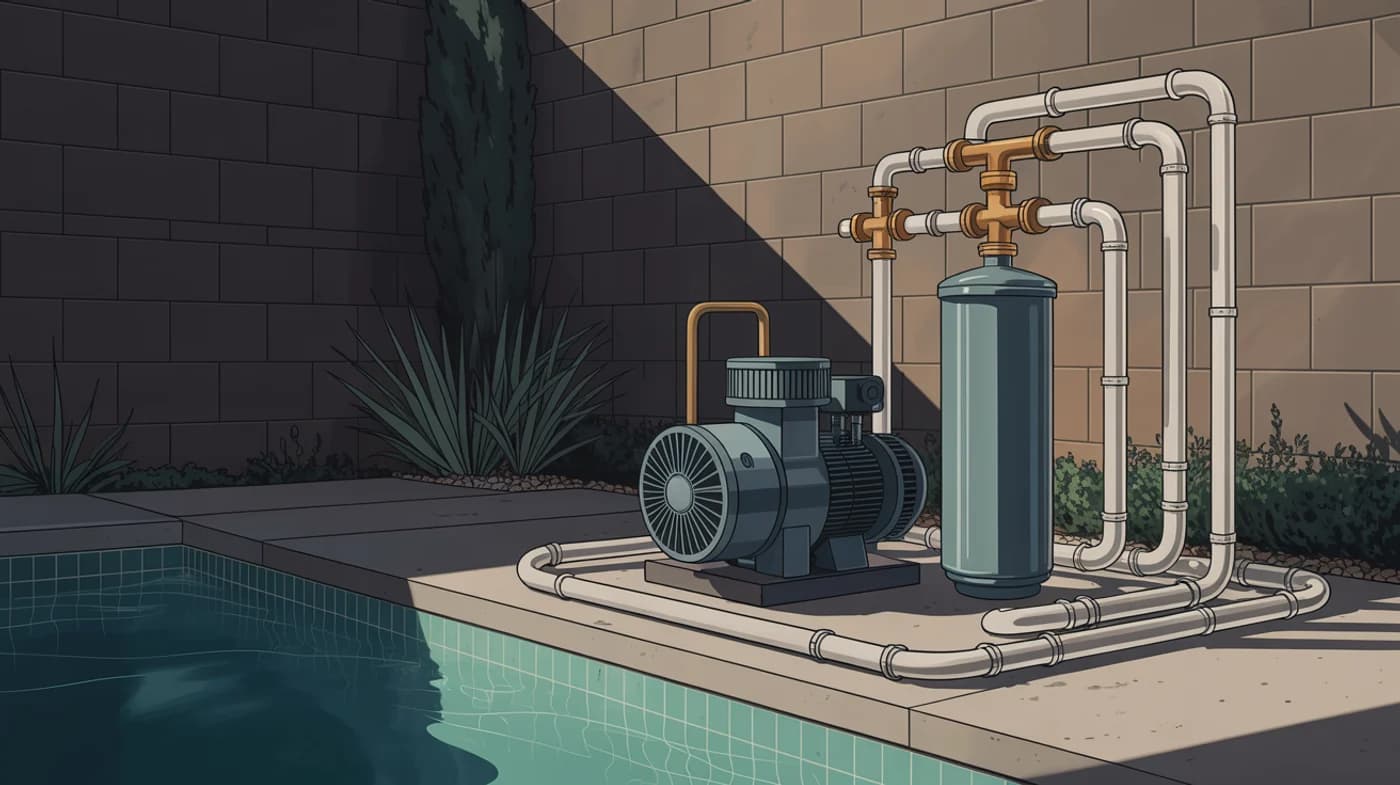
Equipment Installation · Mesa & the East Valley
Your Pool Has
An Engine Room.
Pump, filter, valves, plumbing. Most pads were not designed — they accumulated, one replacement at a time, until nothing quite suited anything else. That is a fixable situation, and it is what we do.
- Designed as one system
- Built to be serviced
- Commissioned and verified
Pool equipment installation is replacing the circulation core — pump, filter, valves and the plumbing that joins them — as a matched system rather than one part at a time. Done properly it means components that suit each other, a layout that can actually be serviced, and a pad commissioned and verified under real operating conditions.
Five Parts, One Machine
It only works as a system
Each part sets the limits of the next. Which is why replacing one in isolation so often moves the problem rather than solving it.
The pump
Moves every gallon through everything else. Sets the flow the rest of the pad has to work with.
Pump installationThe filter
Removes what the water is carrying. Has a design flow limit the pump must respect.
Filter installationThe valves
Decide where water goes and in what proportion. Quietly responsible for a lot of "weak returns".
The plumbing
Sets the ceiling on flow no matter what the pump is rated for. The part nobody photographs and everybody feels.
The pad itself
Layout, clearance and access. Decides whether the next repair takes an hour or a saw.
What happens when you change one thing
A more capable pump onto an old filter
The filter now sees more flow than it was sized for. Pressure climbs faster, cleaning intervals shorten, and the filter gets blamed for a mismatch the pump created.
A bigger filter onto tired plumbing
The pipe is still the restriction. You have bought surface area you cannot use, and the flow barely moves.
New equipment onto a patched pad
The new component is fine and the twenty-year-old union next to it is not. The next leak is somewhere else on the same pad, and it turns up soon.
One component at a time, over years
You end up with a pad of parts that were each correct in isolation and were never designed to work together. This is the most common equipment situation we walk into.
The Honest Question
Is your pad actually due — or is it one part?
Most of the time it is one part, and we will say so. Here is how to tell which situation you are in.
Signs the pad is due
- You have replaced two or three components separately in the last few years
- Servicing anything means cutting pipe because there are no unions
- Nothing on the pad matches, and nobody knows what was installed when
- A leak gets fixed and another appears somewhere else within months
- The layout has no clearance — lids cannot be opened without moving something
- You are already replacing the pump, and the filter and plumbing are the same age
Signs it is not
- One component has failed and the rest is sound and correctly sized
- The plumbing is in good condition and has unions where it needs them
- The pad has room to work and the components suit each other
- The problem is water chemistry or debris rather than equipment
If this is your pad, you want a repair or a single replacement — not a rebuild. That is a cheaper conversation and we would rather have it.
Diagnose the one thingLayout Is Not Cosmetic
The next repair should not need a saw
How a pad is laid out decides what every future repair costs. It is the least glamorous part of an installation and the one you will feel for twenty years.
A pad that fights you
- Components crowded together with no clearance
- Filter lids that cannot be removed without dismantling pipework
- Glued joints where unions belong
- Pipe runs that cross in front of the parts needing access
- No way to isolate one component from the rest
A pad that helps you
- Space around every component, and above every lid
- Unions at the connections that get opened
- Straight runs with sensible bends rather than improvised routes
- Valves positioned so the pad can be isolated section by section
- A layout somebody else can understand at a glance
Unions do not make future work free. What they do is make it a service call instead of a plumbing job, and that difference compounds over the life of a pool.
Local Reality
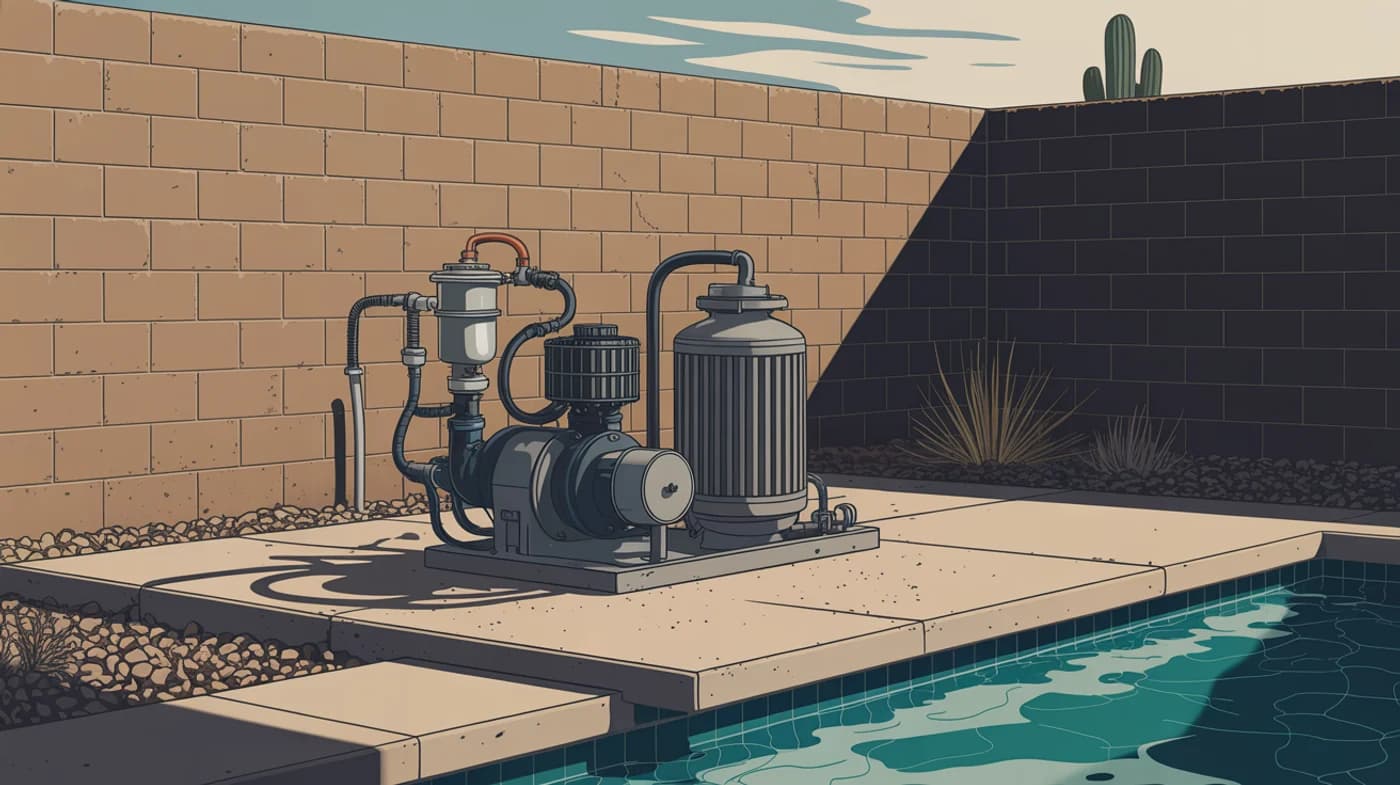
An Arizona pad ages faster than the pool it serves
No plant room, no shade, no off-season. Six conditions do the wearing, and between them they explain most of what we get called out to replace.
The pad lives outdoors, in full sun
No plant room, no shade, no relief. Plastics go brittle, seals harden, and labels fade off components until nobody knows what is installed. An equipment pad here ages faster than the pool it serves.
Heat is hard on motors
Motors shed heat into air that is already 110°F. Combine that with the long runtimes an Arizona season demands and thermal stress becomes the defining wear factor on the pad.
A season that never really stops
There is no winter shutdown to give the equipment a rest. Hours accumulate all year, which is why component ages here are worth tracking rather than guessing.
Hard water works from the inside
Mesa water runs about 12 to 13 grains per gallon. Scale builds inside plumbing and on heat-exchange surfaces, quietly restricting flow in places nobody inspects.
Why the water is this hardMonsoon load
Between 15 June and 30 September, storms push debris through the whole system at once. Baskets fill, filters load, and any weak point on the pad tends to reveal itself.
Dust gets everywhere
Fine desert dust finds motor vents and cooling paths as readily as it finds the filter. A pad that is never cleaned runs hotter than one that is.
Monsoon dates per the National Weather Service. Water hardness per USGS and the City of Mesa.
A Question With No Number
How long does pool equipment last?
We are not going to print a number, because the honest range is too wide for one to mean anything. Two identical pads in the same Mesa street can differ by years depending on runtime, sun exposure, water balance and whether anything has been quietly fighting a restriction.
The more useful question is not "how old is it" but "is it still doing its job, and is it about to stop". That is answerable by looking at it.
Runtime hours
An Arizona pool runs a lot more hours per year than a seasonal one. Hours, not calendar years, do the wearing.
Sun on the pad
A pad in afternoon sun ages materially faster than one with shade or a cover.
Water balance
Aggressive water corrodes and saturated water scales. Both shorten equipment life from the inside.
Whether it has been fighting something
A pump that spent years pushing against a restricted line has done far more work than its age suggests.
Whether anyone was watching
Most equipment gives warning before it fails. Whether that warning was noticed is often the whole difference.
Straight About It
What we install
Pumps and motors
Sized to the system, plumbed for service, programmed and verified.
Filters
Matched to the pump flow and the debris load, with the clean-pressure baseline recorded.
Valves
Replaced and positioned so the pad can actually be isolated and worked on.
Plumbing and re-plumbs
Straight runs, sensible bends, unions where the next person will need them.
Complete pad rebuilds
The circulation core designed as one system rather than assembled by accident.
Commissioning
Primed, purged, leak-checked and verified under real operating conditions.
And what we don't
- Heaters and heat pumps
- Pool lighting
- Automation and control systems
- Electrical work
Plenty of companies list everything. We would rather tell you up front and point you somewhere appropriate than discover halfway through a job that it is not our trade. If your pad needs a heater or an automation controller, you want someone who does that work every week — and we will say so before you have paid us anything.
How A Pad Gets Built
Nine steps, and the third one is where we might talk you out of it
Designing it as a system is the part that makes the other eight worth doing.
Audit the whole pad
Every component, its condition and its age — plus the plumbing between them, which is usually the part nobody has looked at.
Establish what the pool needs
Volume, the jobs the pool has to do, and the flow requirements of anything already installed.
Decide the scope honestly
Sometimes it is one component. Sometimes the pad. We will tell you which, including when the answer is the cheaper one.
Design it as a system
Pump and filter matched to each other, valves where they are useful, and a layout that can be serviced.
Remove what is being replaced
Out cleanly, with what stays properly assessed rather than assumed to be fine.
Plumb it properly
Straight runs, clearance around every component, unions where the next person needs them.
Commission it
Primed, air purged, leak-checked under pressure, and run under real conditions.
Set the baselines
Clean filter pressure recorded and pump speeds programmed for the jobs this pool actually does.
Walk you through it
What each valve does, what the gauge should read, and what to watch for. A pad you understand is a pad you can look after.
Answers
Equipment questions, answered
Including the ones about what we will not take on.
Scope
What pool equipment does Kenney's install?
The circulation core: pumps, filters, valves and the plumbing that connects them, up to complete equipment pad rebuilds. That is the system that moves and cleans your water, and it is what we work on every week.
Do you install pool heaters, lights or automation?
No — and we would rather say so plainly than take the job and learn it is not our trade. Heaters and heat pumps, pool lighting, automation and control systems, and electrical work all sit outside what we take on. If your pad needs those, you want someone who does that work regularly, and we will point you that way before you have paid us anything.
Can you work on my salt system?
We test and balance salt pool water like any other pool — that is water care and it is squarely what we do. Salt cell replacement and generator repair are hardware we do not list, so if the cell itself is the problem we will tell you that rather than quote for it.
When to replace
Should I replace the whole equipment pad or just the broken part?
Usually just the broken part — and we will say so when that is the case. The pad becomes the better answer when components have been replaced piecemeal over years and no longer suit each other, when servicing anything means cutting pipe, or when you are already replacing the pump and the filter and plumbing are the same age. The tell is repeated small failures in different places rather than one clear fault.
How long does pool equipment last in Arizona?
The honest answer is that the range is too wide for a single number to be useful. What drives it is runtime hours rather than calendar years, how much sun the pad takes, whether the water has been balanced, and whether anything has spent years fighting a restriction. A better question is whether it is still doing its job and showing signs of stopping — which is answerable by looking at it.
Why do I keep having equipment problems in different places?
That pattern usually means the pad is at the end of its life as a system rather than that you are unlucky. When components have been added one at a time over many years, they are all roughly the same age and none of them were chosen to work with the others. Fixing them individually keeps working, right up until it becomes more expensive than doing it once.
Should the filter be replaced at the same time as the pump?
Worth considering, because the two work as a system and a new pump changes what the filter sees. A more capable pump pushing more water through an already-marginal filter usually exposes the filter's limits straight away. If the existing filter is healthy and its flow limit suits the new pump, there is no reason to touch it.
The installation
What makes a good equipment pad layout?
Clearance and access, mostly — which sounds mundane until you need to open a filter. Space around every component and above every lid, unions at the connections that get opened, straight pipe runs rather than improvised routes, and valves positioned so one part of the pad can be isolated without shutting everything down. A good pad is one somebody else can understand at a glance.
Why do unions matter so much?
Because without them, servicing a component means cutting pipe and re-gluing it. Unions do not make future work free — what they do is turn a plumbing job back into a service call, and over the life of a pool that difference adds up considerably. It is the single cheapest thing an installer can do for the person who comes next.
Does new equipment need to be programmed?
A variable-speed pump does, and it is where a lot of installations quietly fall short. Operating points have to suit the jobs your pool actually performs — filtration, skimming, cleaner, features — and any equipment with a minimum flow requirement has to be respected. Equipment that is installed but not programmed is running on someone else's defaults.
How much does pool equipment installation cost?
We do not publish figures, because what drives them varies too much: which components, whether the plumbing needs work, the state of the pad, access, and whether it is one item or the whole circulation core. Tell us what you have and we will give you a real number rather than a range that means nothing.
Where We Work
Equipment installation across the East Valley
Get the pad looked at properly
Tell us what has failed and what has been replaced before. If it is one component, that is what we will quote — and if the pad has reached the end of its life as a system, we will show you why.