
Pool Cleaning · Mesa & the East Valley
Pool Cleaning That Doesn't Cut Corners
Pool cleaning is the physical work — skimming, brushing, vacuuming, clearing baskets and checking flow, plus a water test — that keeps a pool clear between visits. This is the most complete pool-cleaning guide in the East Valley: exactly what a clean covers, the water chemistry behind it, and when the problem is bigger than debris.
Free estimate, no obligation — a one-time clean never requires signing up for weekly service, and we'll tell you if you don't actually need us.
- 5.0 from 6 Google reviews
- Licensed technicians
- Residential only
- Free estimates
What You Get
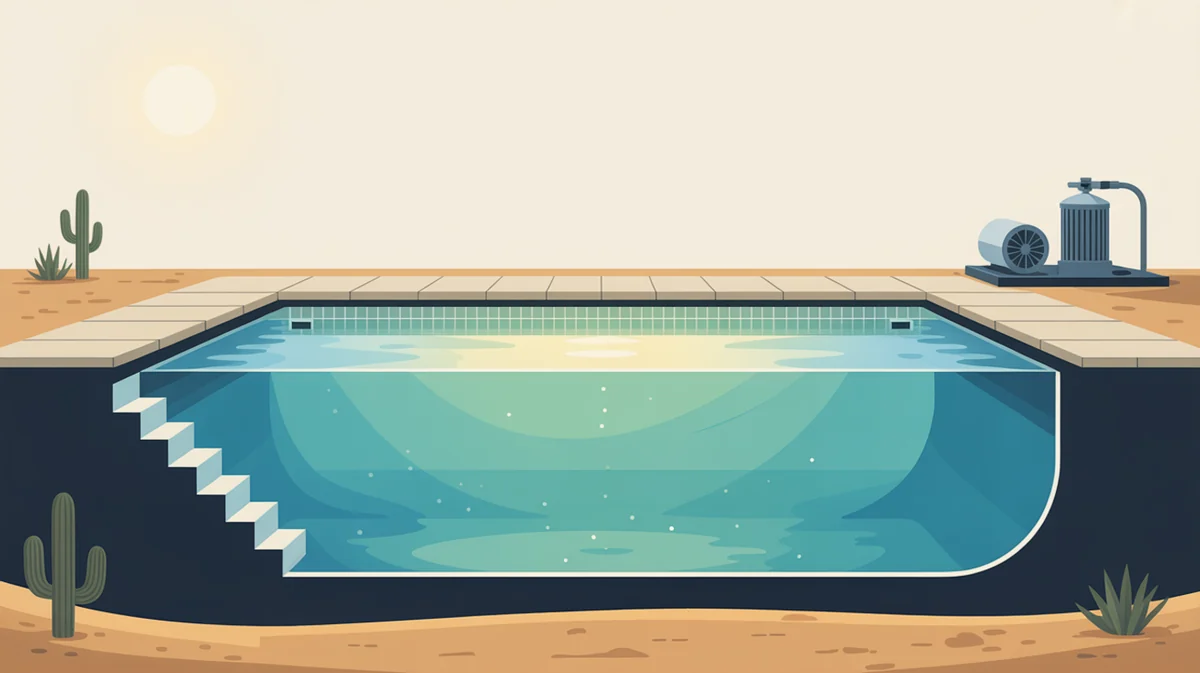
What a professional clean actually touches
No “crystal clear” marketing — the six areas a visit covers, and why each one matters in Arizona.
- 1
Skim & net — Surface
Leaves, blown-in desert litter and floating debris lifted off the top before they waterlog and sink — because once debris settles it stains and feeds algae.
- 2
Brush — Waterline, walls & steps
The band where algae film and calcium start. Brushing breaks the film before it takes hold and slows scale building on the tile line.
- 3
Vacuum — Floor
Settled silt and fine dust lifted out of the pool rather than stirred into the water or pushed through the filter.
- 4
Empty — Skimmer & pump baskets
Cleared every visit so the pump keeps its prime and flow stays up — a full basket quietly starves circulation.
- 5
Check — Filter & flow
Filter pressure read and media inspected. A loaded filter undoes the rest of the visit, so it is checked rather than assumed.
- 6
Test & balance — Water
Chlorine, pH and alkalinity tested and corrected so the water stays clear between visits. Deeper chemistry problems are handled under maintenance.
- Beyond a routine clean: heavier restoration is quoted separately — acid wash, drain & refill, calcium / tile line. We tell you before any of it starts.
How A Visit Goes
Start to finish, every visit
A clean is a sequence, not a splash-and-dash. Here is the order we work in and why it is that order.
Arrive & access
Through the gate to the pool — no need for you to be home if we can get in.
Walk the pool
A quick visual read of water, surfaces and equipment before touching anything.
Test the water
Chlorine, pH and alkalinity checked so the visit is based on numbers, not a guess.
Skim & net
Surface debris off first, before it waterlogs and sinks.
Brush
Walls, steps and the waterline — where algae film and calcium start.
Vacuum
Settled silt and fine desert dust lifted out of the pool.
Baskets & filter
Baskets emptied, filter pressure checked against its clean baseline.
Balance & report back
Chemistry corrected, and we tell you anything we found rather than leaving you guessing.
Land On The Right Service
Cleaning, maintenance, or green-pool recovery?
These get used interchangeably, but they solve different problems. Here is where each one stops and the next begins.
| Pool CleaningYou're here | Pool Maintenance | Green-Pool Recovery | |
|---|---|---|---|
| What it is | The physical work — skim, brush, vacuum, baskets, filter & flow, plus a water test. | Recurring chemistry management and preventative equipment checks, week to week. | A one-time rescue when the water has already turned green. |
| What it fixes | Debris, surface film, early algae and dust — the visible stuff. | Drifting chlorine, pH, alkalinity and scale, and small equipment issues before they fail. | An active algae bloom, cleared with shock, heavy brushing, filtration and vacuuming. |
| When you need it | Ongoing, to keep a healthy pool clear. | To keep the water chemically stable and equipment reliable. | After neglect, a failed pump, or a monsoon knocked the pool out. |
| Where it lives | This page | Pool maintenance | This page |

Why Arizona Is Different
What the desert does to a pool
Cleaning cadence here isn't a guess — five specific conditions make Mesa pools harder to keep clear than most of the country.
Monsoon dust and haboobs
Arizona's monsoon runs June 15 to September 30, with dust storms peaking mid-July through August. A single haboob can load a pool with fine dust in minutes, which is why summer cleans matter most.
Source: NWS PhoenixVery hard water builds scale
Mesa tap water is classed as very hard — around 12–13 grains per gallon, well above the US average. That mineral load is what leaves the calcium line on your tile, so brushing the waterline every visit matters here.
Source: USGS / PHTAExtreme UV burns off chlorine
The Phoenix area sees around 330 sunny days a year and summer UV in the "extreme" range. Ultraviolet degrades unstabilised chlorine, so sanitiser is consumed faster here than almost anywhere — and a pool falls behind quickly without regular attention.
Source: PHTAHeat lets algae establish fast
Warm water plus depleted chlorine is exactly the condition algae needs. In an Arizona summer that window is short, which is why a consistent clean beats catching up after the water has already turned.
Source: CDC Healthy SwimmingDesert landscaping drops debris
Palm, olive and mulberry drop enough pollen and blossom that Phoenix banned planting male olive and mulberry trees back in 1986. Mature East Valley yards shed steadily into the pool year-round.
Source: Phoenix City Code 39-9
The Numbers Behind Clear Water
Pool water chemistry, explained
Clear water isn't luck — it's seven numbers held in range. Here's what each one is, the target a professional balances toward, and why Arizona makes it harder.
Free chlorine
1–3 ppmThe active sanitiser doing the actual disinfecting.
The CDC floor rises to 2 ppm once stabiliser is in the water — and Arizona sun burns chlorine off fast, so it needs watching, not guessing.
pH
7.4–7.6How acidic or basic the water is — it decides how well chlorine actually works.
Above 8.0 chlorine barely disinfects; below 7.0 it corrodes surfaces and stings eyes. Evaporation and hard fill water tend to push pH up here.
Total alkalinity
80–120 ppmThe buffer that keeps pH from swinging every time something changes.
Get this right first and pH stops fighting you. Acceptable band runs 60–180 ppm.
Calcium hardness
200–400 ppmToo low dissolves plaster and grout; too high scales tile and equipment.
Mesa's very hard tap water (~12–13 grains/gal) pushes calcium toward the top of the range — it is exactly what leaves the white line on your tile.
Cyanuric acid (stabiliser)
30–50 ppmSunscreen for your chlorine — it shields sanitiser from UV so it lasts.
Essential in the desert. But it never evaporates, so it slowly concentrates; past ~100 ppm it "locks" chlorine and the fix is replacing water, not adding chemicals.
Salt (saltwater pools)
2,700–3,400 ppmThe level a salt cell needs to generate its own chlorine (≈3,200 ppm is the sweet spot).
Hard water scales the cell and 95°F+ water strains the generator, so salt cells are a wear item in Arizona.
Total dissolved solids
within ~1,500 ppm of startEverything dissolved in the water added together — it dulls sanitiser and clarity as it climbs.
Relentless evaporation concentrates TDS here, which is the main reason desert pools get drained and refilled every few years.
Target ranges per CDC Healthy Swimming and PHTA / ANSI-APSP-11. Ongoing chemistry management is chemical balancing.
Green Pool Prevention
How an Arizona pool goes green — and how we stop it
A green pool is a chain of four steps. Break any link and it doesn't happen. Consistency breaks all four.
How it happens
- 1
Sun strips the chlorine
Extreme UV degrades unstabilised chlorine within hours.
- 2
Sanitiser drops below the line
Free chlorine falls under the level that keeps algae in check.
- 3
Heat + dust feed it
90°F+ water plus organic dust from a haboob is everything algae needs.
- 4
It blooms in days
A clear pool can go green in a Phoenix summer faster than in almost any climate.
How consistent cleaning prevents it
Hold the sanitiser
Free chlorine kept in range every visit, not topped up once it has already failed.
Keep stabiliser right
Enough CYA to protect chlorine from UV — without letting it climb and lock it.
Move the water
Adequate pump runtime and circulation leave algae nowhere still to settle.
Brush and filter
Weekly brushing shears biofilm before it establishes; a clean filter keeps clarity.
Pool Filter Cleaning
Sand, cartridge or DE — and when to clean it
Your filter does the clarity work between visits. Which type you have changes how it's cleaned, how much water it uses, and how often it needs attention.
Sand
Coarsest- How it filters
- Water is pushed through a bed of graded filter sand; debris lodges in the sand.
- How it's cleaned
- Backwashed — reverse the flow to flush debris to waste. Media replaced periodically.
- Water use
- Uses the most water (backwash goes down the drain).
- Best for
- Owners who want the simplest, lowest-cost, low-touch setup.
Cartridge
Middle- How it filters
- Water passes through a large pleated polyester element that traps debris across its surface.
- How it's cleaned
- No backwashing — rinsed off or replaced, with periodic chemical soaks for oils and scale.
- Water use
- Conserves water — nothing is backwashed to waste.
- Best for
- The most common residential choice, and kinder on water in a drought state.
DE
Finest- How it filters
- Diatomaceous-earth powder coats internal grids and forms an ultra-fine filtering layer.
- How it's cleaned
- Backwashed, then recharged with fresh DE powder through the skimmer.
- Water use
- Backwashes to waste like sand, so it uses water.
- Best for
- Owners who want the clearest possible polish and will do a bit more maintenance.
When does a filter need cleaning? Both Pentair and Hayward say clean or backwash when the pressure gauge reads about 10 psi above its clean baseline — and Arizona dust reaches that point faster. All filter types are covered by NSF/ANSI Standard 50.
Filter replacementEyes On The Equipment
We catch small problems early
A clean is also the weekly look that spots a failing part before it strands you with a green pool. What's genuinely part of a clean is below — anything past that becomes a pool repair, and we tell you rather than sell you.
Skimmer & pump baskets
Cleared every visit — a full basket starves the pump.
Filter pressure
Read against its clean baseline; ~10 psi over is the signal it needs cleaning.
Pump prime & flow
Listening for new noise, watching for lost prime or weak return flow.
The equipment pad
A glance for drips, leaks or wet ground that point to a developing problem.
Through The Year
Pool cleaning through an Arizona year
Desert pools don't get 'closed' for winter — but what they need does shift with the season.
Peak demand
Summer
- Chlorine demand and algae risk are at their highest
- Pumps typically run ~10–12 hours a day to keep water turning over
- The season most likely to go green if a pool falls behind
Jun 15 – Sep 30
Monsoon
- Haboob dust loads the water and spikes filter pressure fast
- Clean the filter more often; shock after storms to handle the organic load
- The single hardest stretch of the year on an East Valley pool
Easing off
Fall
- Cooler water holds chlorine longer and slows algae down
- Olive, palm and leaf drop keeps the skimmer working
- A good window to catch up on anything summer let slip
Still open
Winter
- Arizona pools stay open — they are not "closed" like cold-climate pools
- Pumps ease back to ~6–8 hours a day as demand drops
- Cooler water is more forgiving, but chemistry still drifts and needs checking
Monsoon dates per the National Weather Service. Pump-runtime figures are general Arizona service guidance, not a fixed rule.
Routine Clean, Or Something More?
When cleaning alone won't fix it
Some problems look like a dirty pool but aren't. If you're seeing one of these, a clean is not the answer — here's what is.
- Chemical balancing
Water stays cloudy even after you shock it
Cloudiness that will not clear is usually suspended solids or a filtration/chemistry issue — not debris a net can catch.
- Acid wash
A grey or brown shadow on the plaster that brushing will not lift
Staining that has embedded into the surface is past what a clean can reach.
- Acid wash
A hard white or grey line along the tile at the waterline
That is calcium scale from Arizona's very hard water — it needs removing, not more brushing.
- Drain & refill
The water is so far out of range that chemicals cost more than the water
Sometimes replacing the water is cheaper than chasing the chemistry back into range.
- Pool repair
Debris is back within a day or two of every clean
Rapid return can point at circulation or a filter not moving water the way it should.
Straight Answer On Cost
What a cleaning quote is based on
No competitor publishes a real price and neither will we invent one — but here is exactly what we quote on, so an estimate isn't a black box.
Pool size and volume
More water and more surface is more time every visit.
Debris load
Trees overhead, an open vs screened yard, and monsoon exposure all change how much lands in the water.
Current condition
Routine upkeep is one thing; a neglected pool or a first deep clean is another.
Any add-on work
Acid wash, a drain and refill, or heavy scale removal are quoted on top of the clean.
- Estimates are free and carry no obligation. When you get yours, ask how chemical cost is handled for your pool — we'll tell you plainly rather than bury it.
Free Download
The Mesa monsoon pool checklist
A one-page checklist for keeping an East Valley pool clear through haboob season — before the season, before a storm, and after a dust storm hits. Built from the same NWS and PHTA facts above. Yours to keep, no strings.
Proof
What Mesa homeowners say about the cleaning
We've had such a great experience with this pool cleaning company! From the very beginning, they've been reliable, professional, and super easy to work with. Our pool always looks crystal clear, and it's such a relief knowing we don't have to worry about keeping up with it ourselves. They show up on time, communicate well, and go the extra mile to make sure everything is taken care of.
Brandy P. · Google review Kenney was super responsive and reasonably priced. Highly recommend him for your pool cleaning needs!
Robbie B. · Google review Kenney is a very reliable and friendly guy and provides great pool cleaning services!
Damitra M. · Google review
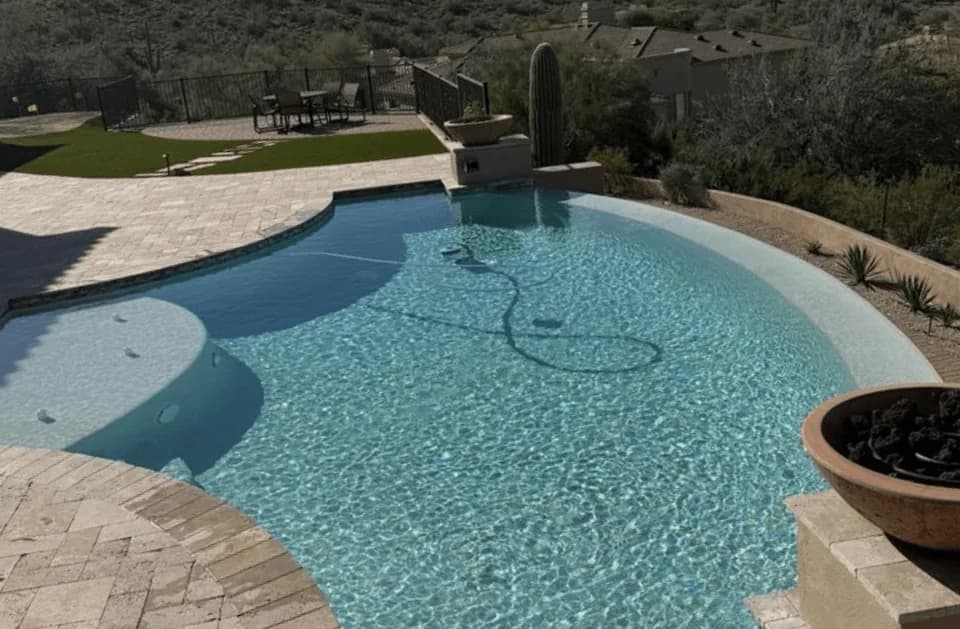
A real East Valley pool — clear water, clean waterline and coping. We keep before-and-after photos of actual jobs on request rather than staging stock images.
Answers
Pool cleaning questions, answered
Sixteen of the questions Mesa pool owners actually search — answered straight, with the standards-body facts behind them.
How often should a pool be cleaned in Mesa?
Weekly for most Mesa pools. Extreme Arizona UV burns off chlorine faster than almost anywhere, summer water temperatures let algae establish within days, and monsoon dust storms load the water fast — so a seven-day cycle is the practical baseline here. Pools under mature trees or in open, dust-exposed yards often need more attention through monsoon season.
What does a standard pool cleaning visit include?
Six things: the surface is skimmed and netted, the waterline, walls and steps are brushed, the floor is vacuumed, the skimmer and pump baskets are emptied, the filter pressure is checked, and the water is tested and balanced for chlorine, pH and alkalinity. Heavier work like acid washing or a drain-and-refill is separate and quoted before it starts.
What is the difference between cleaning and maintenance?
Cleaning is the physical work — skimming, brushing, vacuuming, emptying baskets, checking flow. Maintenance is the recurring chemistry and equipment side — keeping chlorine, pH, alkalinity and hardness in range and catching equipment problems early. A weekly service visit does both; a one-time clean focuses on the physical side. If ongoing chemistry is your real need, our pool maintenance page covers it.
What are the ideal chlorine and pH levels for a pool?
The CDC recommends free chlorine of at least 1 ppm (at least 2 ppm if you use cyanuric acid stabiliser) and pH between 7.2 and 7.8, with 7.4–7.6 the ideal that PHTA cites. Those are the health-and-clarity targets a professional balances toward — not numbers to chase by pouring chemicals in blind.
Why does my chlorine disappear so fast in the Arizona sun?
Ultraviolet light breaks down unstabilised chlorine quickly — much of its strength can be gone within hours of direct summer sun. Cyanuric acid (stabiliser) shields it so it lasts far longer, which is why keeping stabiliser in the right range matters more in the desert than almost anywhere else.
Why does my pool turn green so fast in summer?
Three things stack up: intense UV strips the chlorine, 90°F-plus water lets algae multiply quickly, and dust storms drop organic material straight into the pool. Together they let a clear pool bloom green in days — faster than in milder climates — which is why consistency beats catching up.
How often should a pool filter be cleaned?
The manufacturer rule of thumb (both Pentair and Hayward) is to clean or backwash the filter when its pressure gauge reads roughly 10 psi above the clean starting pressure. In Arizona, dust and monsoon load push that point closer together, so filters often need attention more frequently through summer, plus a periodic deeper soak.
What's the difference between sand, cartridge and DE filters?
DE (diatomaceous earth) filters the finest, cartridge is in the middle, and sand is the coarsest. Sand and DE are backwashed — which sends pool water to waste — while cartridge filters are rinsed or replaced and use no backwash water, which is why they are the most common residential choice in a drought state. All are covered by NSF/ANSI Standard 50.
Why is my pool cloudy even though the chemicals are balanced?
Clarity depends on filtration and circulation as much as chemistry. A dirty or undersized filter, too little pump runtime, dead spots with poor flow, very early algae, or suspended fine desert dust can all keep water hazy even when your chlorine and pH test fine.
Can a green pool be cleaned without draining it?
Usually, yes. Most green pools clear with shock treatment, continuous filtration and repeated brushing and vacuuming — light blooms in a couple of days, most within a week. Draining becomes the better option only when algae has stained the plaster, or the water chemistry is so far out of range that correcting it would cost more than replacing the water.
How often does an Arizona pool need to be drained and refilled?
Typically every few years. Because water evaporates but dissolved solids and stabiliser do not, they slowly concentrate — high total dissolved solids or cyanuric acid that has climbed past about 100 ppm are the usual triggers. At that point replacing the water is cheaper and more effective than chasing the chemistry.
Do I need to be home for a cleaning visit?
No, as long as we have gate access and any pets are secured. Most homeowners are at work during their service window. If anything needs your attention, we let you know rather than proceeding on our own judgement.
Do you do one-time cleans, or only weekly service?
Both. A lot of homeowners start with a single deep clean — after a move, a monsoon, or a stretch of neglect — and decide from there whether they want us back on a weekly schedule. There is no obligation to sign up for recurring service to get a one-time clean.
Are chemicals included in the price?
Testing and balancing the water — chlorine, pH and alkalinity — is part of every clean. If your pool needs a larger chemical treatment or a specialty product, we tell you what it needs and what it costs before doing it, rather than surprising you on the invoice. Ask us how chemical cost works for your specific pool when you get your estimate.
How should I prepare my pool before going on vacation?
Balance the water and boost stabiliser before you go so chlorine lasts, clear the baskets, leave the pump running enough hours a day to keep water turning over, and check the equipment pad for leaks. For longer summer trips, ask us about keeping it covered with service while you are away.
Is a saltwater pool easier to look after in Arizona?
A salt system makes chlorine automatically, so levels stay steadier with less hands-on dosing — but it still needs weekly testing, and Arizona is hard on it: hard water scales the salt cell and high summer water temperatures strain the generator, so cells are a periodic replacement item. It is less work day to day, not no work.
Leaving Town
Pool care while you're away
An Arizona pool left alone in July can be green by the time you land. Before a trip:
- Balance the water and boost stabiliser before you leave, so chlorine lasts
- Clear the skimmer and pump baskets
- Leave the pump running enough hours a day to keep water turning over
- Check the equipment pad for any drips or leaks
- Secure loose furniture and toys away from the water
Away for longer? Ask us about keeping it covered with service while you're gone.
Where We Work
Pool cleaning across the East Valley
Kenney's serves six East Valley cities — including East Mesa and the neighbourhoods around Superstition Springs and Las Sendas.
Related Services
Often needed alongside a clean
- Pool MaintenanceOngoing weekly care and water chemistry
- Chemical BalancingWhen the water won’t stay clear
- Acid WashEmbedded stains and calcium the clean can’t reach
- Pool DrainingWhen the water is past correcting
- Pool RepairPumps, filters and equipment that have failed
- Filter InstallationReplacing a filter at the end of its life
Get a pool cleaning estimate in Mesa
Tell us what your pool is doing. Free estimate, honest recommendation, and we'll say so if a clean isn't what you actually need.